99% accurate, 100% relevant

Classification that knows what your data means, not just what it looks like.

Go beyond patterns and data elements to see what's actually sensitive in your specific environment, including the things other tools would typically miss.

Your data doesn't exist in a silo. Your classifier shouldn't either.

Most DSPM tools classify data in a silo. What gets missed is everything around it: the document it lives in, who can access it, where it's stored.

Teleskope analyzes the entire context that surrounds your data, correctly identifying 99%+ of your business-critical data.

Built for the data that matters to your business.

Teleskope understands document context, data relationships, and business meaning. The result: high-confidence classification that enables automation.
Enforce

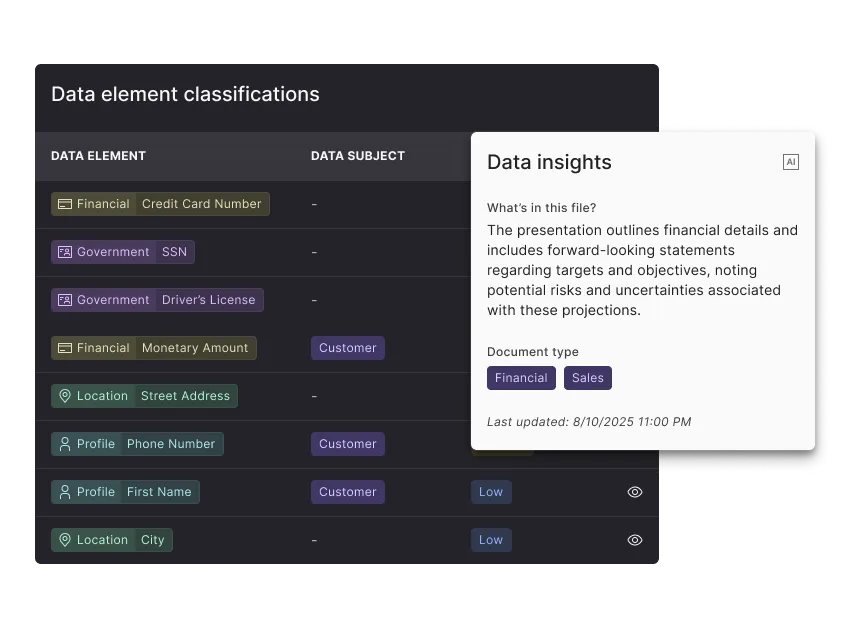
Context-aware classification

Most classifiers answer a binary question: does this data match a known sensitive pattern? Teleskope asks a different one: is this data actually sensitive in this particular context?

Teleskope assesses the risks within context. Who has access to this data? What document does it live in? What is your business profile and risk appetite? It also learns from your policies what you define as sensitive, delivering high-confidence classification ready for automated action.

Understand — Context-aware Classification
Enforce

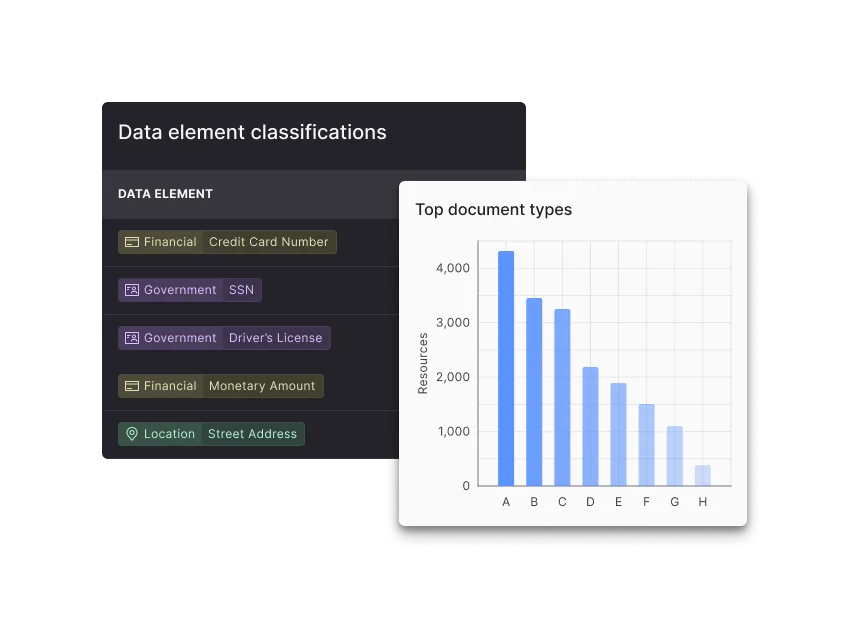
Document intelligence beyond data fields

In addition to data element scans, Teleskope's Prism classifies the document itself, understanding what it is, and whether it's sensitive as a whole rather than because of any individual field it contains.

Prism can identify similar sensitive documents based on known examples without requiring predefined rules. Show it five examples of sensitive legal documents, and it identifies hundreds more across your environment.

Understand — Teleskope Prism
Enforce

AI Search

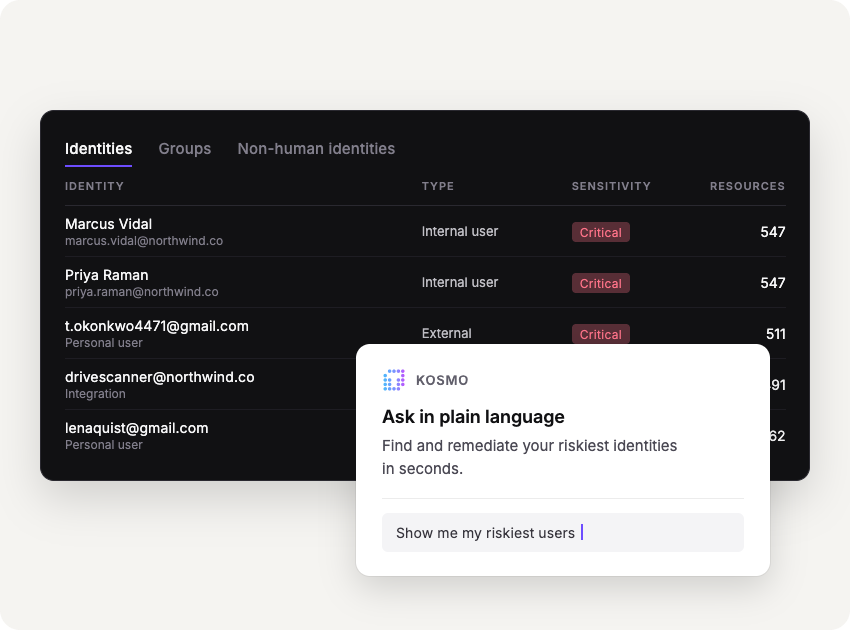
Stop writing queries. Ask the question you actually have in plain language, and Teleskope finds the data that answers it.

Pattern-based search only finds what you already know to look for. Prompt-based AI search lets you chase a hypothesis: "Find all files shared externally that contain contract terms and haven't been accessed in six months." That's a search. No syntax, no Boolean logic, no analyst required. Just the question and the answer.

Understand — AI Search
Enforce

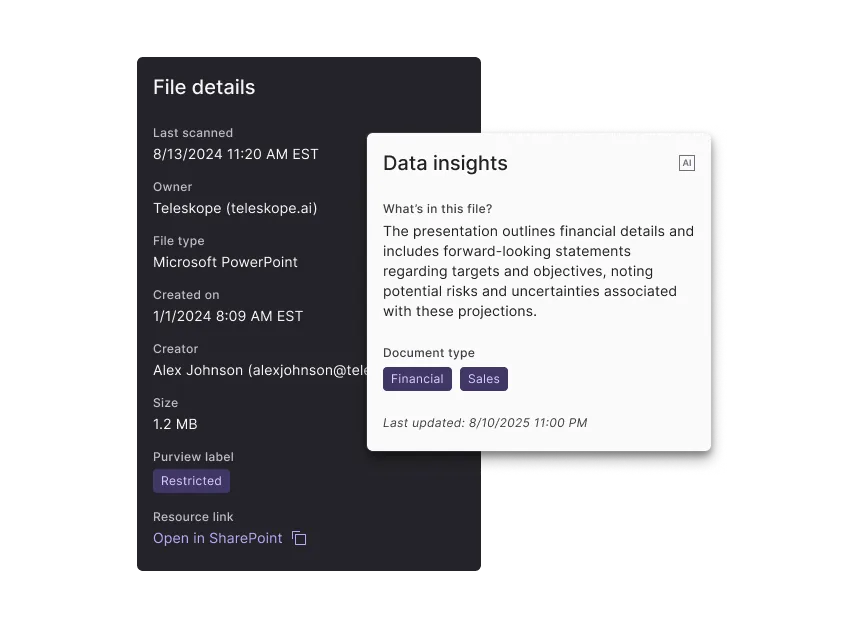
Continuously updated data map

Data changes constantly: new files created, modified, copied, access granted or revoked. Teleskope supports it with its event-driven architecture built for real-time risk identification and remediation, particularly important for the world where AI is ubiquitous.

New sensitive data is classified as it appears. Modified data is reclassified as it changes. The data map reflects your environment as it is right now, not as it was during your last scan.

Understand — Continuously Updated Data Map

Understanding is the first step of Teleskope's Data Reasoning Layer.

Accurate classification is what makes everything that follows possible. When Teleskope understands what data is actually sensitive — in context, for your specific business — the Decide step can determine the right response, and the Enforce step can act on it with confidence.
Learn how the Data Reasoning Layer works

Built for the data that matters to your business.

How Aprio Operationalized Data Security with Teleskope
industry:
Financial Services

How Aprio Operationalized Data Security with Teleskope

Media

How The Atlantic Reduced Time Spent on Data Deletions by 95% with Teleskope

Fintech

How Ramp Achieves Real-Time Data Redaction with Teleskope

From the Field

Aprio

"Teleskope allows us to easily identify where our data is without a lot of overhead and protect our information very quickly."

Lock Langdon
VP IT Operations & CISO

"A lot of tools in security,but you're kind of just stuck with a lot more work. WithTeleskope, we had a full report that said: here are your power users, here are users that never used anything."

Kevin Qiu
Security Leader
careem

"As a customer, we've seen Teleskope cut through alert fatigue and actually fix issues — auto-detecting sensitive data, adding the right context, and triggering smart remediation across different stacks. This is what modern data security should feel like."

Zain Ahmed
Staff Data Security & Privacy Analyst (Global)

Frequently Asked
Questions

Have more questions?
Contact us
Contact us
Got questions? We’ve got answers.

How is Teleskope's classification different from Microsoft Purview's?

arrow down

Purview's classification is primarily regex and keyword-based — it finds things that look like known sensitive data types. It works reasonably well for standard PII but generates significant false positives in complex environments and cannot classify business-specific sensitive data without extensive custom rule-writing. Teleskope's classification engine uses multi-stage machine learning with contextual understanding — it learns your environment and classifies what's actually risky in your specific context. Many Teleskope customers run both: Teleskope provides accurate classification, which feeds Purview with reliable MIP labels that dramatically improve Purview's enforcement accuracy.

Can Teleskope classify data in custom or proprietary systems?

arrow down

Yes — and this is one of the most common reasons teams choose Teleskope over alternatives. Standard classifiers rely on field names and data structures that match their training data. When a Salesforce environment has been heavily customized, or a CRM was built in-house fifteen years ago, those tools fail. Teleskope's classification engine understands data in context — what the data means, not just what it looks like — which is why it works in non-standard environments where other tools stop functioning.

How does Teleskope handle test data versus production data?

arrow down

Teleskope can be configured to understand your environment's data boundaries — which systems are test, which are production, which are staging. This context applies to classification so test data containing realistic-looking sensitive fields is not treated as production risk. This eliminates one of the largest sources of false positive fatigue in data security programs.

What is Prism and how is it different from standard document classification?

arrow down

Prism is Teleskope's document intelligence capability. Standard classifiers scan for data fields within documents — they find SSNs, credit card numbers, names. Prism classifies the document as a whole — understanding what it is, what it means in your business context, and whether it's sensitive regardless of what individual fields it contains. Prism can also identify similar sensitive documents based on known examples, without requiring you to write rules that define what "similar" means.

Does Teleskope scan every file or does it sample?

arrow down

Teleskope scans every file — it does not rely on sampling approaches that introduce false negative risk. Sampling-based classification, used by some competitors, means files that aren't sampled can contain sensitive data that never gets detected. At the scale of a modern enterprise, even a small sampling gap represents significant undetected exposure. Every file is classified. Classification runs continuously.

How does classification accuracy affect automated remediation?

arrow down

Directly and significantly. Automated remediation is only safe to run at scale when classification is accurate enough to trust. If the classifier generates significant false positives, automation acts on findings that aren't real — closing access that was legitimate, flagging documents that aren't sensitive, creating friction without reducing risk. Teleskope's classification engine is designed specifically to be accurate enough for automated action — which is why the Decide and Enforce steps of the Data Reasoning Layer can operate with confidence.

Related Products

Your backlog isn’t a resource problem. It’s a tooling problem.

See how Teleskope resolves high-confidence data exposure automatically 
— starting in your first session.
Book a Demo
Book a Demo