






Your engineers ship fast. Your sensitive data ships with them, into S3 buckets and AI coding tools nobody reviewed.

Discover, classify, and remediate sensitive data across cloud databases, SaaS tools, and AI environments, deployed inside your own cloud if your security team requires it.
Teleskope dashboard flagging publicly shared files containing credit card numbers, SSNs, and passwords as critical risk
Customers using Teleskope for Technology

Teleskope for Technology

Modern tech companies run on custom, polyglot data stacks regex-based tools were never built to classify. Teleskope understands your environment on your terms, and fixes what it finds automatically.

Classify without writing a rule

Automatically classify PII across production databases, backups, and logs, including DynamoDB, MongoDB, and object storage.

Revoke public access automatically

Pull public access to cloud storage buckets and misconfigured shares before an outsider finds them.

Enable safe AI coding

Block sensitive data and source code from reaching external AI tools and coding assistants before it leaves your environment.

Remove stale access automatically

Clear stale service accounts and API keys based on evidence of actual use, not an annual review.

Powered by Teleskope's Data Reasoning Layer, which understands your business context, determines the appropriate action, and enforces it natively. No tickets. No manual triage. No waiting.

Understand your data

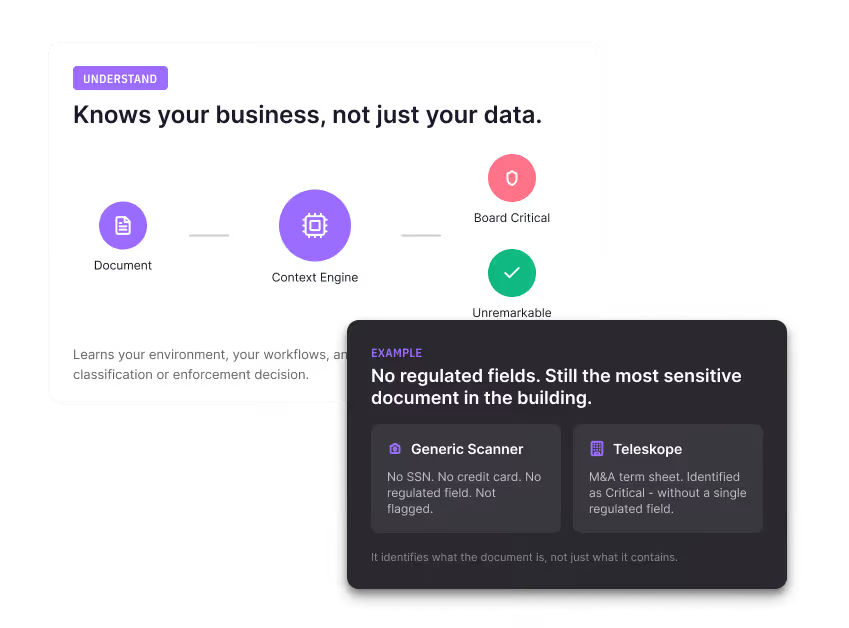
Teleskope reads your environment the way a senior platform engineer would, understanding schema and business context across every database and cloud service, including the custom ones. It knows a support-ticket field that looks like a phone number probably is one, and that a proprietary algorithm has no predefined pattern but is still your most sensitive asset.
Teleskope's context engine classifying a document as business-critical even with no regulated fields

Decide what's risky

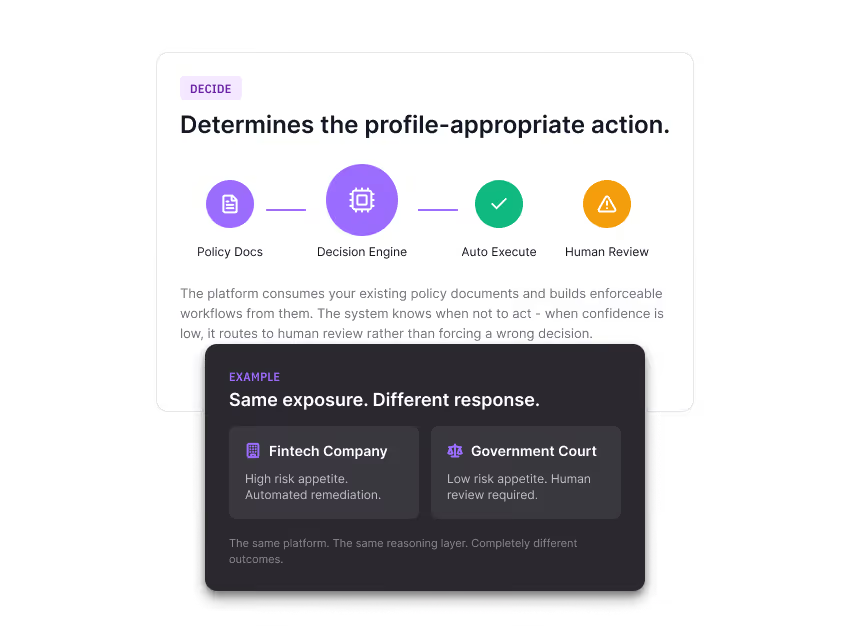
Once Teleskope understands what it's looking at, it weighs data sensitivity, business context, and your policies, whether that's SOC 2, ISO 27001, or a customer contract specifying data residency, to decide the right response. A public storage bucket triggers revocation. A backup under a newer privacy law, like India's DPDP Act, triggers a retention review.
Teleskope's decision engine choosing automated remediation or human review based on risk profile

Enforce your policies

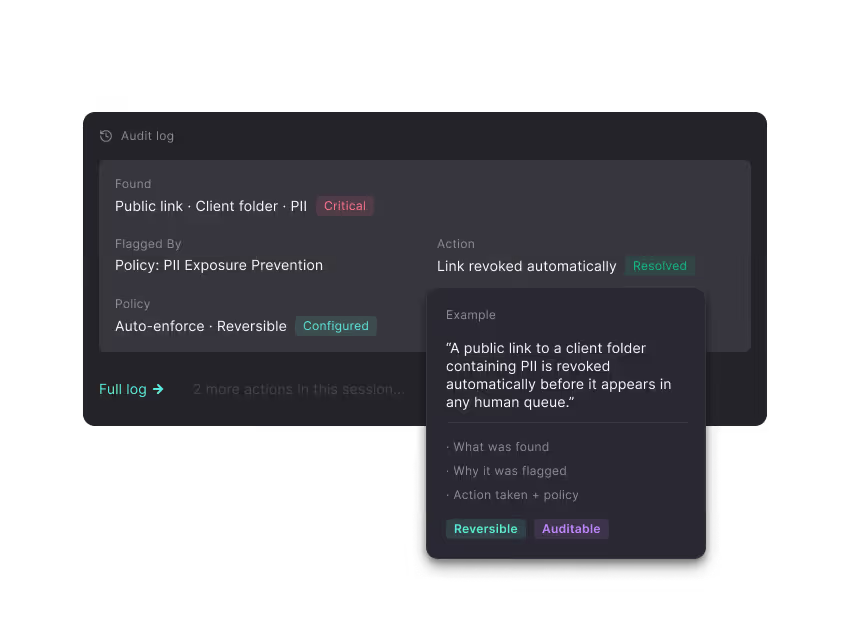
Teleskope acts natively across your stack, in Slack, cloud storage, and your databases, no ticket, no backlog item, no queue. It deploys the way your team already works: inside your own cloud, self-hosted, or fully managed. Every action is logged with what was found, why it mattered, and what was done.
Teleskope audit log showing a public link to PII auto-revoked and resolved before human review

“Our data reserves are constantly increasing, which makes classification and privacy management difficult. Teleskope was the perfect solution to keep our growing data footprint secure.”

Ayush Chauhan
Zomato — deployed via Bring Your Own Cloud, 2x faster classification, 30GB classified in 9 hours

Frequently Asked
Questions

Have more questions?
Contact us
Contact us

We're cloud-native already. Doesn't our cloud provider's native security cover this?

arrow down

Native cloud security tools are good at infrastructure-level controls, not at understanding what your data actually is. They'll tell you a bucket is public. They won't tell you if it contains an SSN or a marketing asset. Teleskope classifies based on business context and remediates the specific exposure, the gap native tooling leaves open.

Our data lives across a dozen different databases and file formats. Can Teleskope actually keep up?

arrow down

This is where pattern-matching tools fail first. Teleskope's classification engine understands data in context rather than matching a predefined schema, so it works across DynamoDB, MongoDB, SQL, object storage, and custom formats without you writing detection rules for each one.

How is this different from Cyera?

arrow down

Cyera is the strongest cloud-native DSPM competitor we're compared to in this segment. Its classification is sampling-based, not every file is scanned, which introduces false negative risk at scale, and its remediation runs through external tools rather than natively. Teleskope scans every file, not a sample, and remediates directly in the platform that found the exposure.

Can we deploy this inside our own cloud instead of a third-party SaaS?

arrow down

Yes. Zomato runs Teleskope through a Bring Your Own Cloud deployment, so all its data stays inside its own environment. Teleskope also supports fully self-hosted and air-gapped deployments for companies with stricter data residency or contract requirements.

We ship constantly. Won't a security tool slow us down?

arrow down

This is the objection we hear most, and it's what the deployment model answers. Zomato went from proof-of-concept to full deployment using a Helm chart, with three requested features shipped along the way. Teleskope is built to keep pace with an engineering org that ships weekly, not to become the thing that blocks the release.

What happens if Teleskope gets a remediation wrong?

arrow down

Every action is reversible and logged. If access is revoked or data is quarantined incorrectly, it can be restored immediately, with an audit trail showing exactly what happened, why, and under which policy.

Your backlog isn’t a resource problem. It’s a tooling problem.

See how Teleskope resolves high-confidence data exposure automatically 
— starting in your first session.
Book a Demo
Book a Demo