














Manage Data Sprawl & Lifecycle Risk

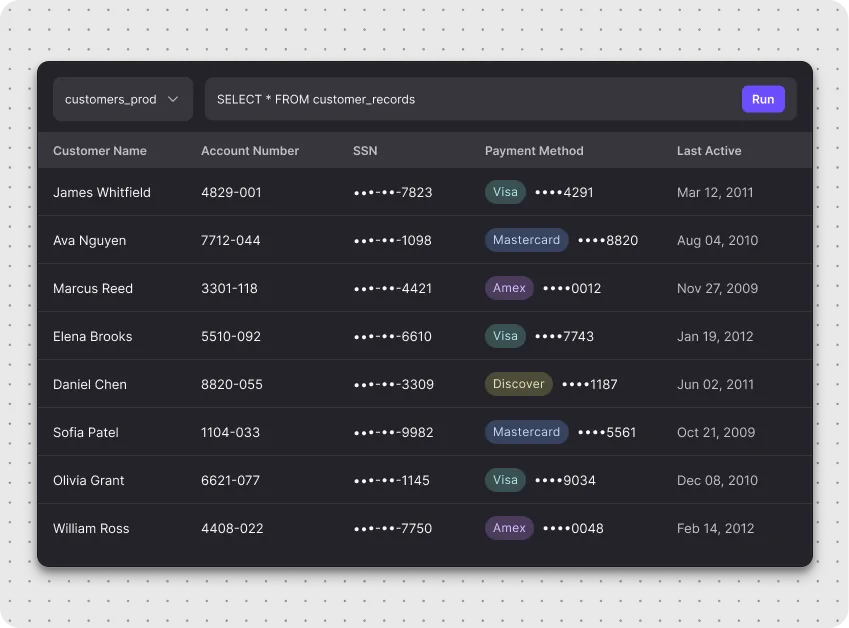
Petabytes of data. Most of it is doing nothing except making you a bigger target.

Automatically identify, eliminate, and govern redundant, obsolete, and risky data across your entire environment — so your team stops managing data you shouldn't even have.
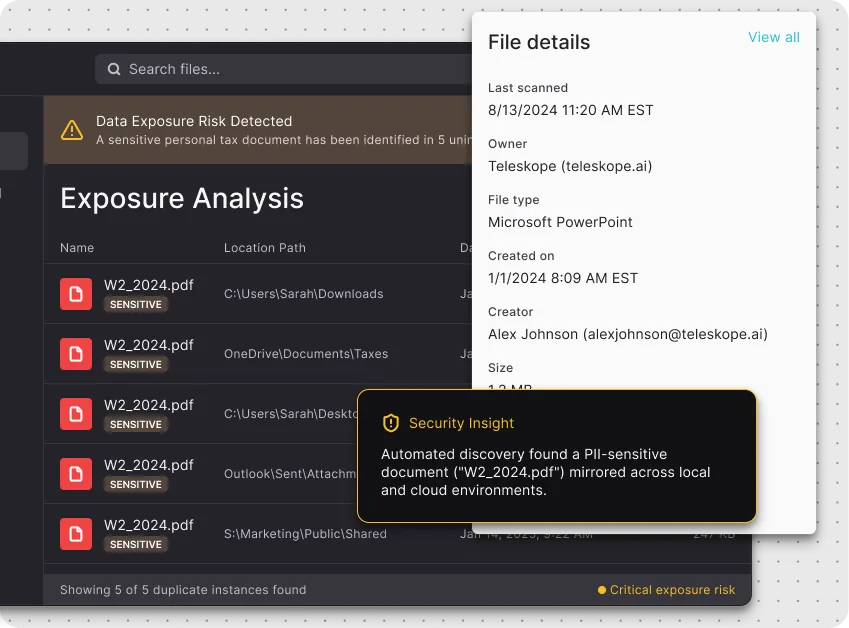
Teleskope dashboard flagging publicly shared files containing credit card numbers, SSNs, and passwords as critical risk
Customers who trust Teleskope to manage data sprawl:

Teleskope for Data Sprawl & Lifecycle Risk

Teleskope finds redundant, obsolete, and misplaced data, understands whether it should exist, and eliminates or relocates it: automatically, according to your retention policies, with a full audit trail and flexible human-in-the-loop controls.

Eliminate ROT data

Find and eliminate redundant, obsolete, and trivial data before it becomes a liability

Purge automatically

Enforce retention policies and automatically purge data once it reaches its expiration

Move sensitive data

Move sensitive data from unsecured locations to approved, governed repositories

Assign data ownership

Maintain a continuously updated picture of where your sensitive data lives, who owns it and who can reach it

From detection to auto-remediation in one platform

Understand data lifecycle

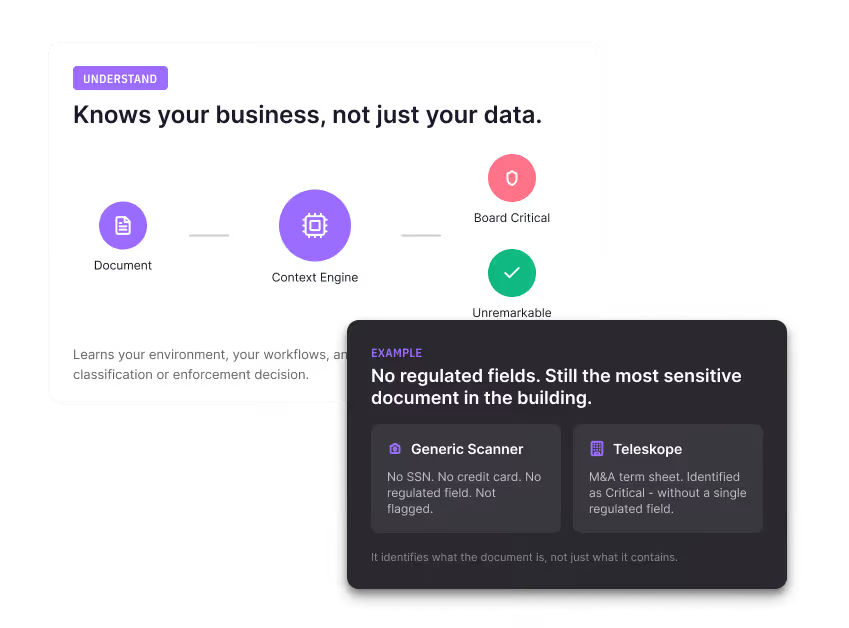
Teleskope maps your data landscape continuously by identifying redundant copies, expired records, and data that has outlived its business purpose. It understands what data exists but knows whether it should be deleted, cross-referencing sensitive data elements, document type, age, business context, and your retention policies.
Teleskope's context engine classifying a document as business-critical even with no regulated fields

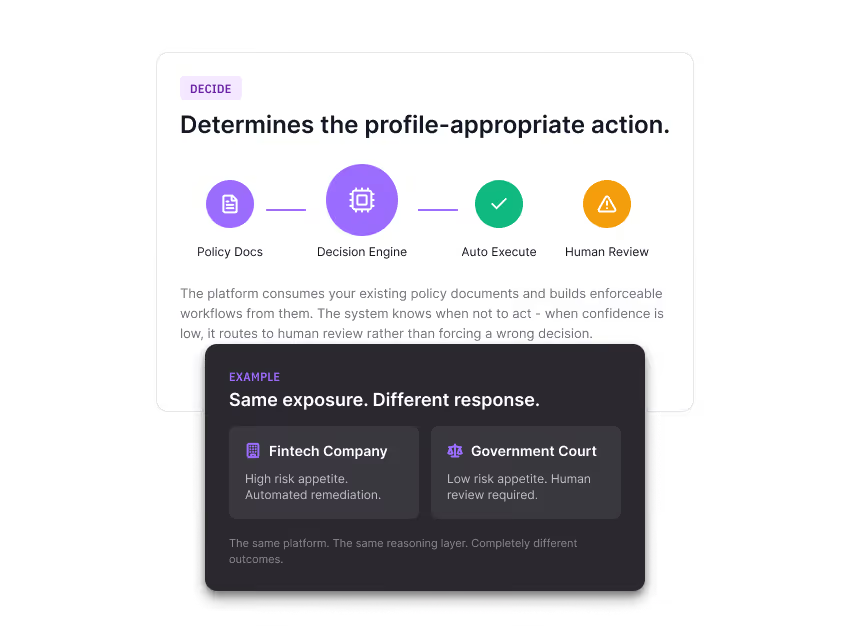
Decide which action to take

For each piece of data identified as redundant, expired, or misplaced, Teleskope determines the right lifecycle action: purge, archive, relocate, or flag for human review. High-confidence decisions are automated, others are surfaced for the human judgment they actually require.
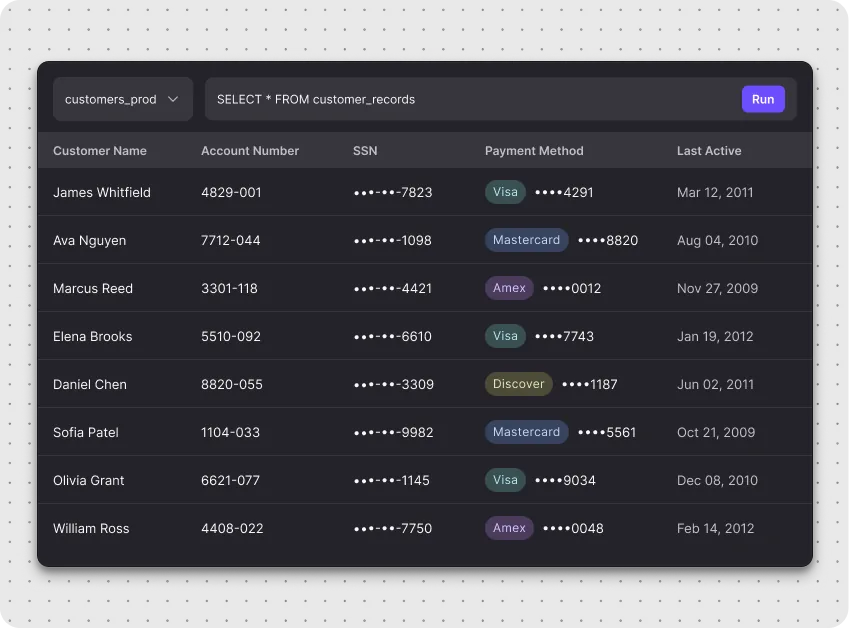
Teleskope's decision engine choosing automated remediation or human review based on risk profile

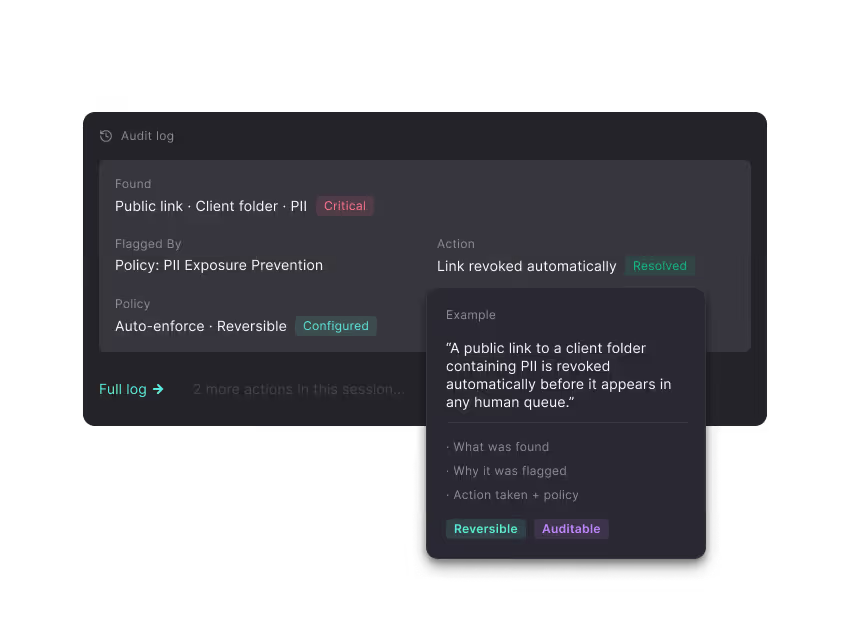
Enforce it automatically

Retention policies are enforced continuously and automatically, not as a quarterly cleanup project but as a continuous operation. Expired data is purged, misplaced data is relocated, and every action is logged with the evidence trail your legal and compliance teams need.
Teleskope audit log showing a public link to PII auto-revoked and resolved before human review

"I've been in the DLP space for a long time and tested a lot of providers. Teleskope is the latest and greatest. They built exactly what we needed, moved fast, and continue to deliver at Ramp's pace."

Security Leader

Frequently Asked
Questions

Have more questions?
Contact us
Contact us

How does Teleskope know what to delete versus what to keep?

arrow down

Teleskope enforces the retention policies you define — it doesn't make unilateral decisions. You set the rules: what data types, what retention periods, what exceptions. The Reasoning Layer then applies those rules continuously and automatically, with human-in-the-loop review for anything that doesn't meet the threshold for high-confidence automated action. Nothing is deleted without a policy authorizing it.

We're worried about deleting something we'll need later. What's the safety net?

arrow down

Every deletion action can be preceded by a quarantine period — data moves to governed cold storage before permanent deletion. During the quarantine window, anyone who needs the data can retrieve it. After the window closes without a retrieval request, the deletion completes. This approach dramatically reduces resistance from business users while still achieving the liability reduction the security and legal teams need.

What's the ROI case for managing data sprawl?

arrow down

Three categories of measurable return: storage cost reduction (eliminating ROT data and unnecessary copies), legal liability reduction (data you don't have can't be subpoenaed, breached, or subject to DSAR requests), and operational cost reduction (automated retention enforcement frees the team hours previously spent on manual cleanup). The storage and licensing cost savings alone are often significant — every copy of every file carries backup, storage, and licensing costs that compound over time.

Our data is in dozens of systems. Can Teleskope actually cover all of them?

arrow down

Teleskope is built for complex, heterogeneous environments — not just cloud-native or Microsoft-centric stacks. It covers cloud, SaaS, on-premises, and AI environments from a single platform, without agents or heavy infrastructure. Critically, it doesn't rely on signature-based matching that fails in customized environments — it understands data in context, which means it works in homegrown CRMs, custom Salesforce configurations, and non-standard database structures where other tools stop functioning.

How does this work with our existing data retention policy?

arrow down

Teleskope ingests your existing retention policy and enforces it automatically — you don't need to rebuild your governance framework. If your policy is incomplete or inconsistently defined, Teleskope's discovery output gives you the factual foundation to have the retention policy conversation with legal and compliance for the first time with real data, not estimates.

What happens if a deletion action was wrong?

arrow down

Every action Teleskope takes is reversible within the quarantine window and fully logged. The audit trail shows exactly what was removed, when, under which policy, and by what trigger — satisfying EU AI Act and ISO 42001 requirements for human oversight of automated decisions.

Your backlog isn’t a resource problem. It’s a tooling problem.

See how Teleskope resolves high-confidence data exposure automatically 
— starting in your first session.
Book a Demo
Book a Demo