3x faster policy creation

Knowing what's risky is only useful if you know what to do about it.

Turn classification into action by ingesting your existing policies, determining the case-appropriate response, and surfacing only what genuinely requires human judgment.

Alert or ignore. There has to be a better way.

Data security isn't binary. Between "do nothing" and "delete everything" is a full range of actions, each appropriate for a different exposure, data type, or context.

Teleskope determines that action based on your policies, making automated remediation possible.

The right action, based on your policies and risk appetite.

Teleskope takes what it understands about your data and your environment, applies your policies, and determines the response that's right for your specific situation.
Enforce

Policy ingestion

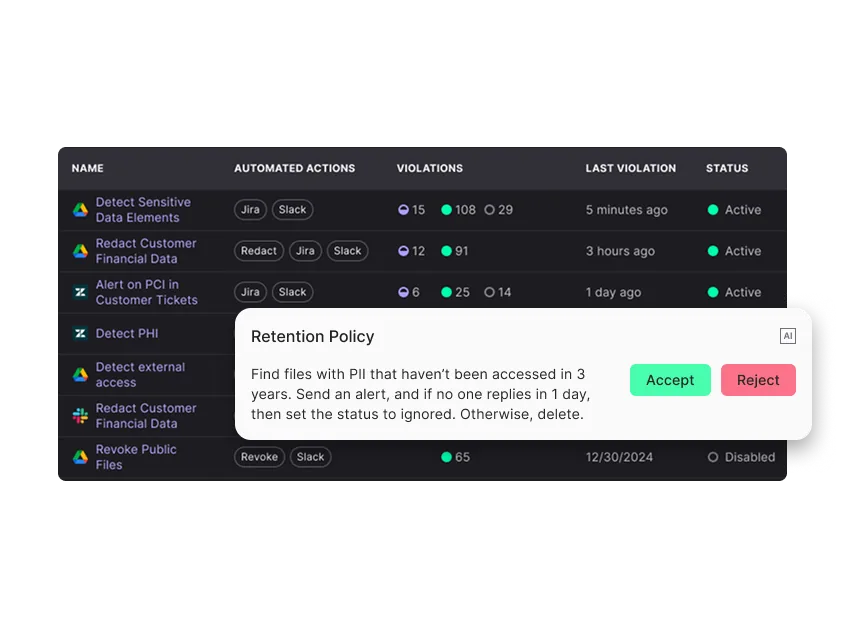
Most organizations have data governance policies: retention schedules, data classification frameworks, privacy guidelines. These often saved in documents that security tools never touch.

Teleskope ingests those documents. It reads your existing policies in natural language and translates them into enforceable workflows, without requiring security engineering to manually recode every rule.

Decide — Policy Ingestion
Enforce

Policy workflow builder

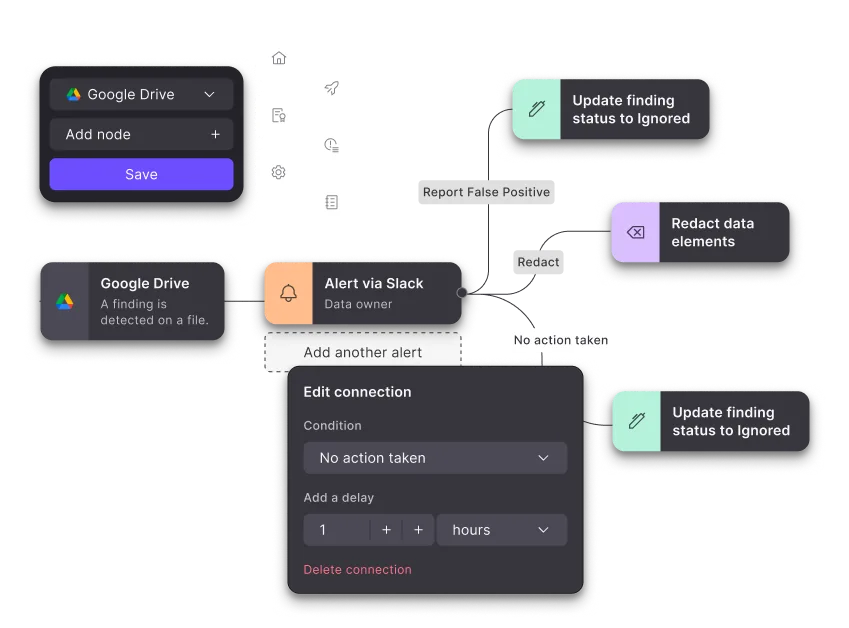
When existing policies need to be extended or new workflows need to be created, the Workflow Builder makes it fast and seamless to create automation for any user, beyond engineers.

Create policies by adding triggers, filters, alerts, actions, and outcomes into a visual flow that mirrors how you want issues handled. Workflows branch based on responses and triggers. Everything is visible, configurable, and reviewable before it runs.

Decide — Policy Workflow Builder
Enforce

Policy simulation

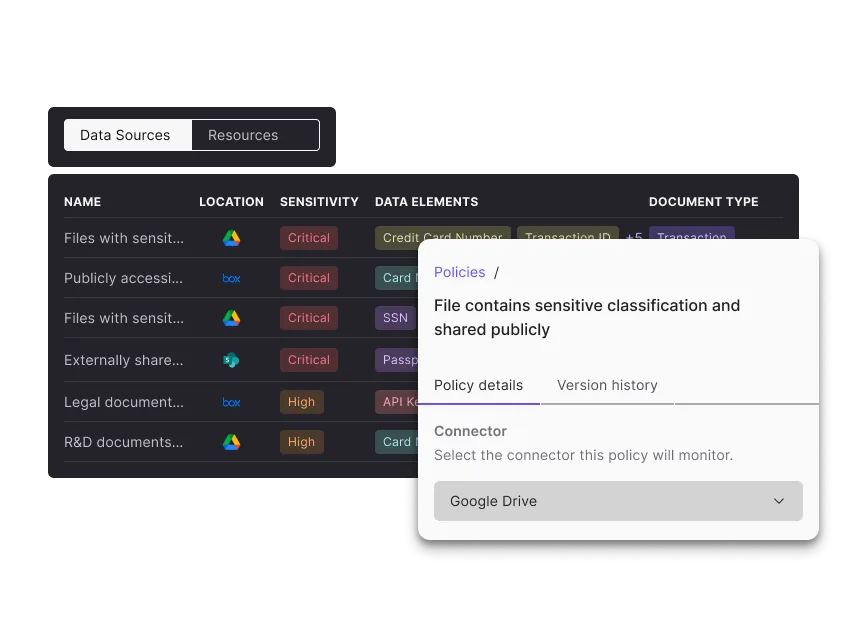
Before a policy goes live, Policy Simulation shows exactly how many resources it would touch — so you can validate intent before enforcement begins.

This matters most when expanding automation into new territory. A policy that looks right on paper can have unintended scope. Simulation makes that visible at the review stage, not after an action has already run.

Decide — Policy Simulation
Enforce

Determine the most appropriate action

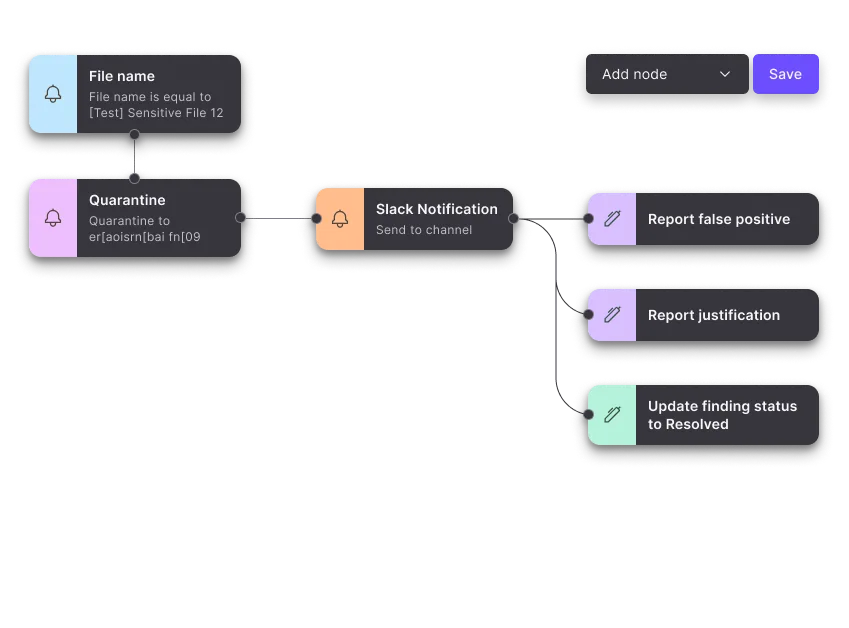
Not every exposure calls for the same response. With Teleskope you can notify the user, redact, quarantine, revoke, relocate, delete, or loop in security teams when their judgment is required.

Teleskope determines the appropriate action by combining what it knows about the data, the context around it, and the organization's business profile, policies, and configured risk appetite.

Decide — Determine the Most Appropriate Action

Decide is the second step of Teleskope's Data Reasoning Layer.

The Decide step only works because the Understand step has already built an accurate picture of what the data is and why it matters. And its value grows exponentially when the Enforce step acts on its decisions natively without routing to a queue or an external tool.
Learn how the Data Reasoning Layer works

The right action, based on your policies and risk appetite.

How Aprio Operationalized Data Security with Teleskope
industry:
Financial Services

How Aprio Operationalized Data Security with Teleskope

Media

How The Atlantic Reduced Time Spent on Data Deletions by 95% with Teleskope

Fintech

How Ramp Achieves Real-Time Data Redaction with Teleskope

From the Field

"Teleskope helps you understand what's wrong with your data access governance and tells you what to do about it."

Security Leader
careem

"As a customer, we've seen Teleskope cut through alert fatigue and actually fix issues — auto-detecting sensitive data, adding the right context, and triggering smart remediation across different stacks. This is what modern data security should feel like."

Zain Ahmed
Staff Data Security & Privacy Analyst (Global)

Frequently Asked
Questions

Have more questions?
Contact us
Contact us
Got questions? We’ve got answers.

We already have policies. Does Teleskope replace them or enforce them?

arrow down

Enforce them. Teleskope ingests your existing policies — retention schedules, data classification frameworks, regulatory requirements — and translates them into enforceable workflows. The policies your legal and compliance teams developed stay authoritative. Teleskope makes them operational. If your policies need to evolve, the Policy Workflow Builder makes updating them accessible to non-engineers.

How does the Policy Workflow Builder differ from a traditional policy engine?

arrow down

Traditional policy engines require security engineers to translate business intent into technical rules — a process that's slow, brittle, and inaccessible to the compliance and legal teams who actually own the policies. The Policy Workflow Builder uses a visual, node-based interface that mirrors how humans think about workflows. Compliance teams can build and adjust policies directly. The output is a structured, enforceable workflow — not a rule someone hand-coded.

What happens when the system isn't confident enough to act automatically?

arrow down

It routes the case to human review with full context: what was found, how it was classified, what options are available, and what the system recommends. The goal is to surface only what genuinely requires human judgment — not to create a new alert queue. In practice, the vast majority of high-confidence, well-understood exposures are handled automatically. Edge cases and ambiguous situations reach the team with everything they need to make a fast, informed decision.

Can different parts of our organization have different enforcement rules?

arrow down

Yes. Risk appetite is configurable at multiple levels — by organization, by environment, by data type, by user group. A production database and a development environment can have different rules. A highly regulated business unit can have stricter enforcement than a general operations team. Teleskope applies the right policy in the right context — not a single rule across every finding.

How does the Decide step handle legal hold scenarios?

arrow down

Legal hold is a specific policy workflow — when a hold is triggered (by litigation, regulatory inquiry, or internal investigation), Teleskope can apply it immediately across all connected environments. Data subject to the hold is preserved, protected from deletion, and flagged for legal review. The response is as fast as the trigger — not dependent on a manual process that takes days to reach every system.

What is Policy Simulation and when will it be available?

arrow down

Policy Simulation lets teams preview exactly how many resources a policy would affect before it runs — showing the blast radius of any enforcement action before it becomes real. It closes the gap between "we wrote this policy" and "we're confident deploying this policy." It's coming soon.

Related Products

Your backlog isn’t a resource problem. It’s a tooling problem.

See how Teleskope resolves high-confidence data exposure automatically 
— starting in your first session.
Book a Demo
Book a Demo