Built in. Not bolted on.

The missing layer between finding risk and fixing it.

Every DSPM finds exposure. None of them built the layer that decides what to do next based on your business context & policies, and actually does it. Teleskope did.

The gap between classification and remediation is where exposure lives

Classification and remediation have always been treated as separate problems solved by separate tools and manual handoffs.

Teleskope's Data Reasoning Layer addresses this in one platform, finding what's sensitive and enforcing your policies natively.

Two second detection. 97% lower deletion costs. 100% data coverage.

Teleskope connects classification and enforcement with built-in intelligence that decides what to do, and does it natively.
Enforce

Understand

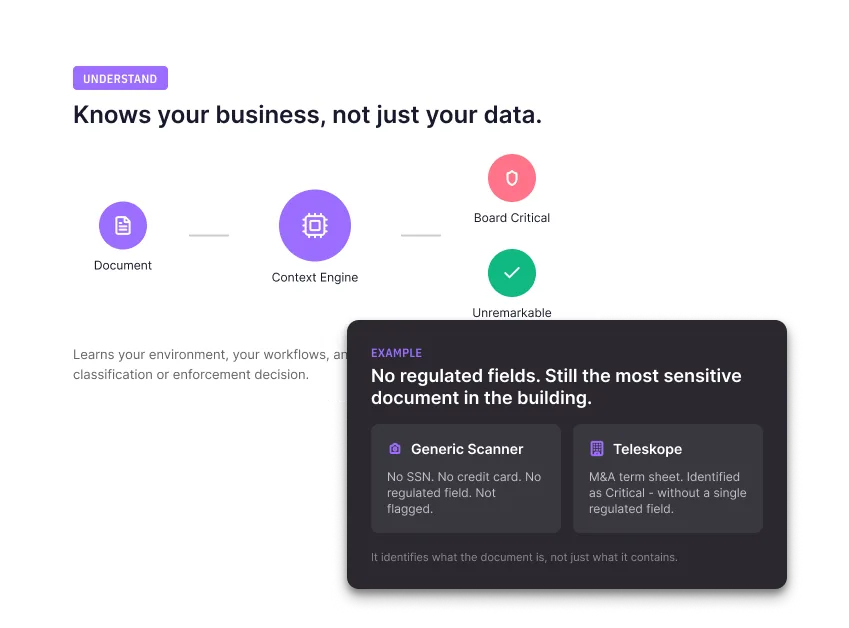
Knows your business, not just your data.

Learns your environment, your workflows, and your risk profile before making any classification or enforcement decision. It builds a model of what sensitive data looks like in your specific organization: not a generic model applied to your data, but a model of your data, built from your data.

It knows that a 1099 containing an SSN is expected for a tax advisory firm. It knows that a CEO's strategic plan is board-level sensitive even though it contains no regulated field. It knows that a chemical manufacturer's proprietary process is critical IP, without a rule that says "look for formulas."
Data Reasoning Layer — Understand
Enforce

Decide

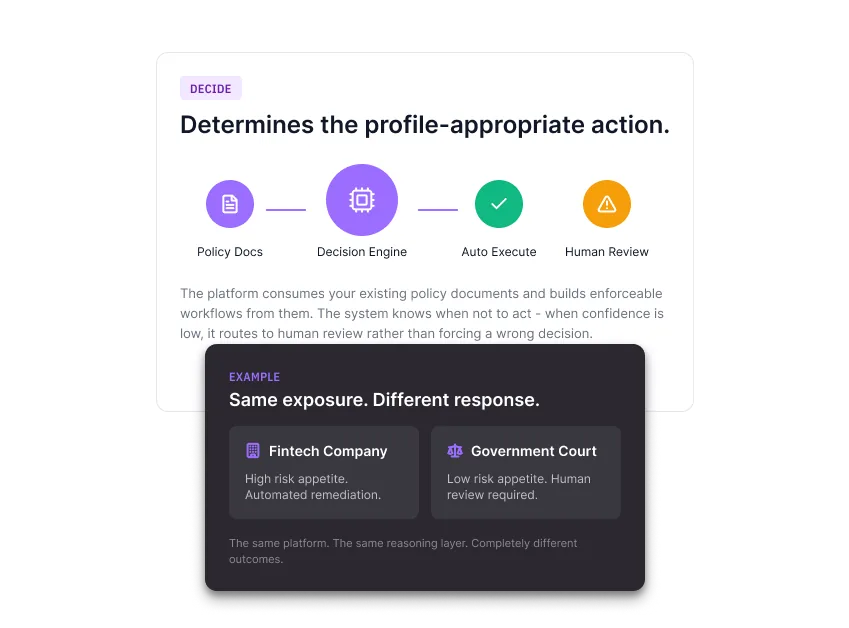
Determines the profile-appropriate action.

Not a generic action, but the action that's right for your organization, your policies, and your risk appetite. The platform consumes your existing policy documents and builds enforceable workflows from them. It advises on the next best action depending on the context and executes automatically on high-confidence decisions.

The system knows when not to act. When confidence is low, it routes to human review rather than forcing a wrong decision. A missed classification surfaced for human review costs far less than a confident misclassification that triggers the wrong automated action.

Data Reasoning Layer — Decide
Enforce

Enforce

Acts natively. No ticket, no integration, no wait.

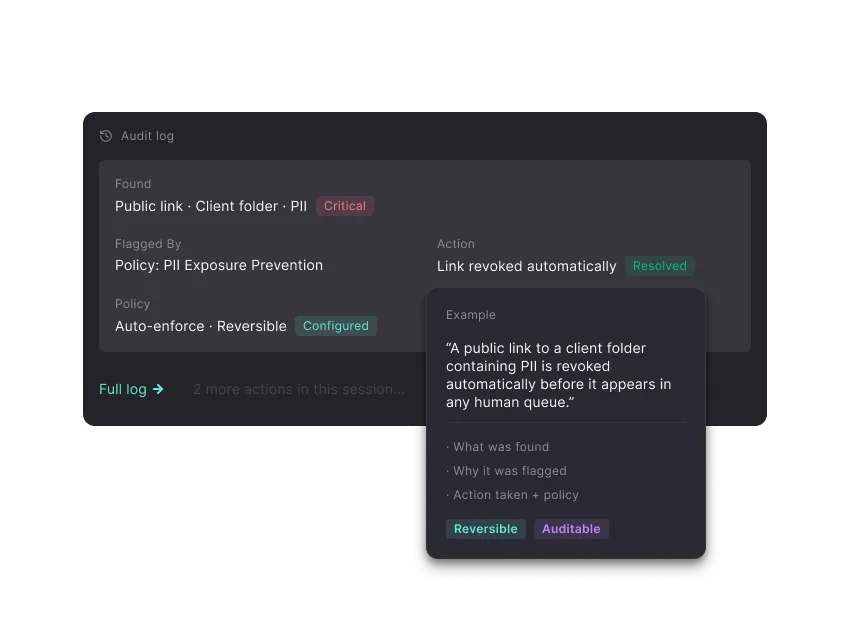
Teleskope resolves exposure directly in the same platform that classifies the data and learns your policies. No ticket to a queue. No API call to an external tool. No workflow that routes to a human who routes to another system. The exposure is closed in the same session it was found, with a full audit trail, within your guardrails, reversible if needed.

Every action is governed, auditable, and reversible. Before automation runs at scale, you define the guardrails: what actions are permitted automatically, what requires human confirmation, what is never automated. Nothing is permanently deleted without explicit policy authorization.

Data Reasoning Layer — Enforce

Every capability, powered by Teleskope’s Data Reasoning Layer.

The Data Reasoning Layer is the intelligence that unities classification with policies, making a context-aware decision about what to do, and executing that decision natively with human-in-the-loop automations.
Learn how the Data Reasoning Layer works

Two second detection. 97% lower deletion costs. 100% data coverage.

How Aprio Operationalized Data Security with Teleskope
industry:
Financial Services

How Aprio Operationalized Data Security with Teleskope

Media

How The Atlantic Reduced Time Spent on Data Deletions by 95% with Teleskope

Fintech

How Ramp Achieves Real-Time Data Redaction with Teleskope

Deployed across fintech, healthcare, manufacturing, hospitality, and the public sector.

Aprio

"For the first time, we have a platform that not only finds sensitive data across our systems but also understands context and takes action automatically. It feels like having a full data management team embedded in our environment, giving us confidence to innovate while keeping our data protected."

Lock Langdon
CISO
Ramp

"A lot of DSPMs, they identify the risk but don't automate the action. It kind of just works without me having to necessarily micromanage it at all times — which is a huge benefit for us because we just don't have that operational capacity."

Alvin Zhang
Security Ops
The Atlantic

"Teleskope was the only solution that did everything we needed, from data deletions to vendor coordination and PII detection. The platform has become a staple across our data security workflows."

Aline Rollenhagen
Executive Director of Data

Frequently Asked
Questions

Have more questions?
Contact us
Contact us
Got questions? We’ve got answers.

What makes the Data Reasoning Layer different from a standard policy engine?

arrow down

A standard policy engine applies rules. If the data matches the rule, the action fires. If it doesn't, nothing happens. The Data Reasoning Layer understands context before applying any rule — it knows what the data means, whether it's actually risky in this specific environment, and what the appropriate response is given the organization's policies and risk appetite. It also knows when to abstain: when risk appetite is low, it routes to human review rather than forcing a decision through a rule that doesn't fit.

How is this different from what competitors like Cyera or Sentra offer?

arrow down

Unlike Cyera and Sentra, Teleskope's classification models are rooted in business context. Further, Teleskope is the only tool that offers a native Decide layer and a native Enforce step. Other tools' remediation routes through external tools, ticketing systems, or manual workflows. Teleskope closes the loop in the same platform. That distinction is what makes automated enforcement at scale actually possible.

Is the Data Reasoning Layer a product or an architectural component?

arrow down

It's an architectural component — the intelligence layer that powers every capability in Teleskope. Understand, Decide, and Enforce are expressions of it applied to specific problems. You don't buy the Data Reasoning Layer separately — it's what makes every other capability on the platform work the way it does.

How does the DRL handle situations it's not confident about?

arrow down

This is one of the most important design decisions in the platform. When the Reasoning Layer's confidence falls below the threshold for automated action, it doesn't force a decision — it routes the case to human review with full context: what was found, why it was flagged, what options are available. A wrong confident decision that triggers the wrong automated action is far more costly than a correct abstention that surfaces for human judgment.

How does the Data Reasoning Layer stay current as my environment changes?

arrow down

The DRL operates continuously: it doesn't run on a schedule or require a periodic rescan. As new data appears, as access patterns change, as policies are updated, the Reasoning Layer updates its model of your environment in real time. The data map it maintains is always current, which is what makes continuous automated remediation safe to run at scale.

What audit trail does the Data Reasoning Layer generate?

arrow down

Every action the DRL takes is logged with full context: what data was found, how it was classified, what the confidence level was, what policy applied, what action was taken, and when. This satisfies EU AI Act and ISO 42001 requirements for human oversight of automated decisions. Every action is also reversible within a configurable window: if a remediation action was wrong, it can be undone.

Related Products

Your backlog isn’t a resource problem. It’s a tooling problem.

See how Teleskope resolves high-confidence data exposure automatically 
— starting in your first session.
Book a Demo
Book a Demo