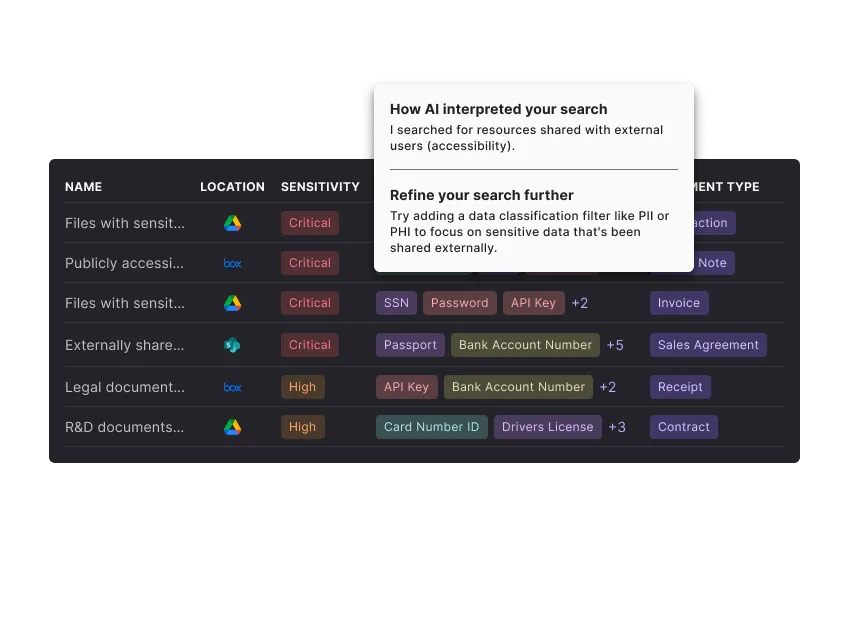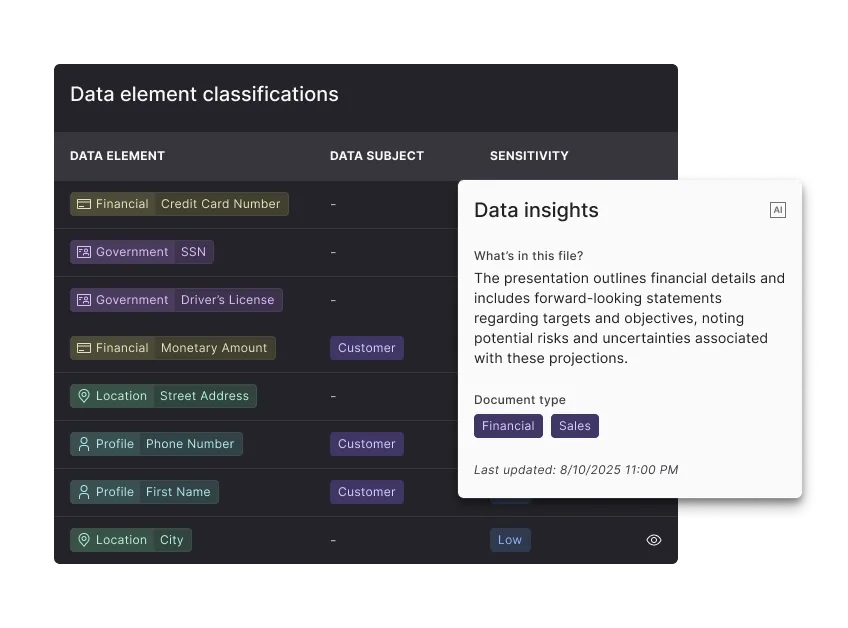
Detect and remediate. In under 2 seconds

Most platforms stop at the finding risk. We close it.

Resolves data exposure automatically without routing to a ticketing system, calling an external tool, or creating a queue for someone to process.

Discovery without remediation is just a longer to-do list.

Finding risk and fixing it have always been treated as two separate problems, solved by two different tools, often by two different teams.

Teleskope closes that gap — natively, automatically, with human-in-the-loop controls and a full audit trail.

Auto-remediation with human-in-the-loop controls. Native. Governed. Reversible.

Teleskope executes across the entire spectrum of remediation actions, automatically or with human confirmation.
Enforce

Native remediation

When DSPM vendors say remediation, they mean a handoff to ServiceNow or a SOAR platform. The exposure is still open while the ticket sits unactioned.

Teleskope's remediation is built into the same platform that classified the risk and determined the response. The action happens in the same session as the detection. No handoff. No queue. No dependency on another tool being configured correctly.
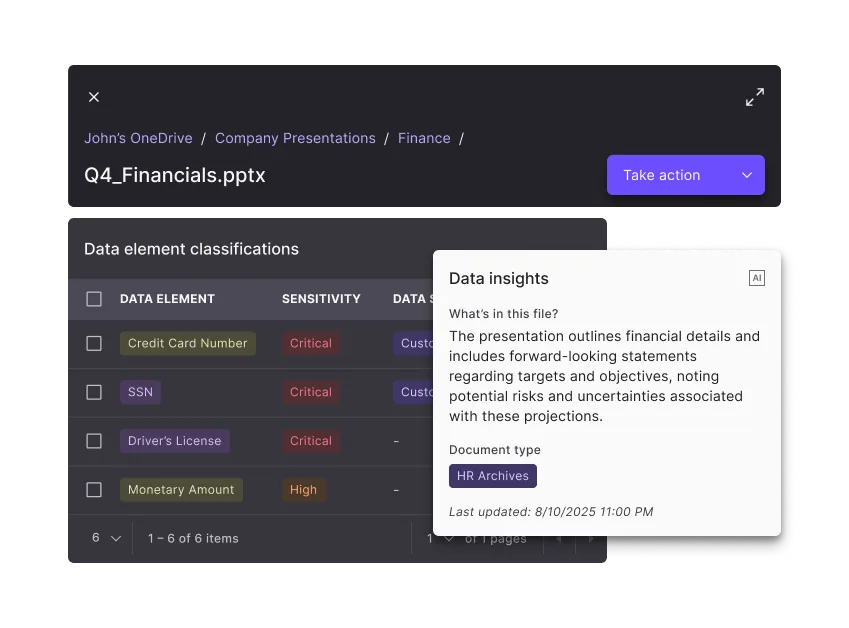
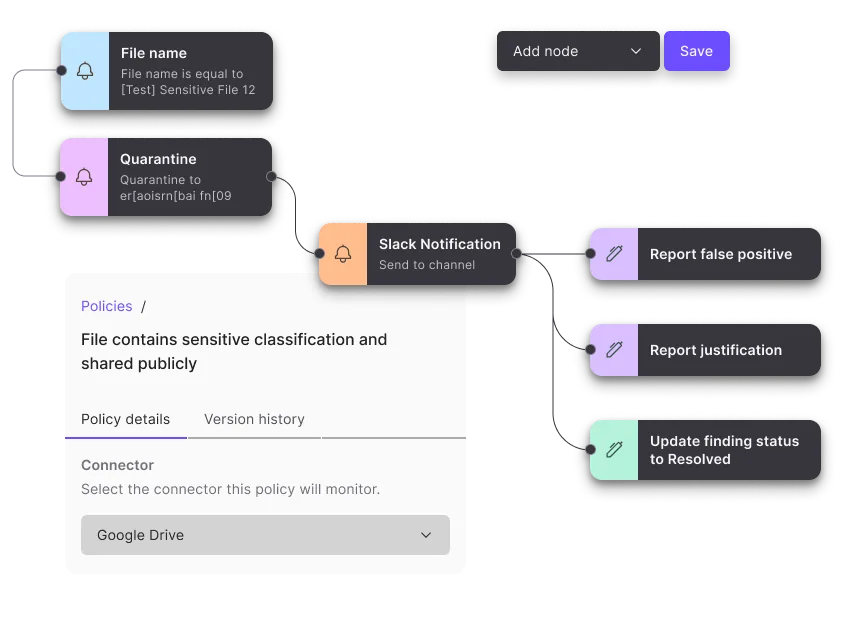
Enforce — Native Remediation
Enforce

Automation with human-in-the-loop controls

Automation without control isn't automation — it's a liability. Every enforcement action in Teleskope runs within guardrails you define before automation starts.

Set your high-confidence, well-understood exposures to run automatically. Surface edge cases, ambiguous findings, and situations below the confidence threshold for human review with full context and a recommended action.

Enforce — Governed Automation
Enforce

Auditable and reversible

Every enforcement action is logged with full context: what data was found, how it was classified, which policy applied, what action was taken, when it ran, and who or what authorized it.

Every action is reversible within a configurable window. Nothing is permanently deleted without explicit policy authorization — and even then, a quarantine period precedes deletion so recovery is possible if needed. This satisfies EU AI Act and ISO 42001 requirements for human oversight of automated decisions.

Enforce — Auditable and Reversible
Enforce

Continuous enforcement

Enforcement runs continuously, triggered by new data appearing, access changing, policies updating, or a new identified exposure that meets the threshold for action.

Your data environment changes every minute: employees leave the company, new ones join, documents and their copies get created and shared, all of it accelerated by genAI tools. Teleskope ensures real-time remediation for all of it, 24/7 365 days a year.

Enforce — Continuous Enforcement

Enforce is the third step of Teleskope's Data Reasoning Layer.

Native enforcement is only safe to run at scale because the Understand step produces classification accurate enough to trust, and the Decide step determines responses that are calibrated to your specific environment. Remove either of those steps, and enforcement becomes a liability rather than an asset.
Learn how the Data Reasoning Layer works

Auto-remediation with human-in-the-loop controls. Native. Governed. Reversible.

How Aprio Operationalized Data Security with Teleskope
industry:
Financial Services

How Aprio Operationalized Data Security with Teleskope

Media

How The Atlantic Reduced Time Spent on Data Deletions by 95% with Teleskope

Fintech

How Ramp Achieves Real-Time Data Redaction with Teleskope

From the Field

San Jancito College

"There's so much more that this product does — when it adds in the remediation piece, that's critical to me not having to employ additional FTEs."

Chuck Layton
Data Management Officer / Former CISO Johnson Space Center

"By the end of the project, we were able to tell our board: we have a ton of PHI, we did this initiative, we gathered all this info, and we actually reduced access significantly — here are the results."

Kevin Qiu
Security Leader
Aprio

"Teleskope gave us that nice blend of both discovery and enforcement - the ability to implement fairly simple, easy-to-develop controls to prevent things like public file sharing, to prevent certain information from leaking, or even redacting at scale."

Lock Langdon
VP IT Operations & CISO
The Atlantic

"Our data team was spending a significant amount of time executing deletions, which took them away from other valuable work. We needed a solution that would streamline our data security workflows at scale."

Aline Rollenhagen
Executive Director of Data

Frequently Asked
Questions

Have more questions?
Contact us
Contact us
Got questions? We’ve got answers.

How is Teleskope's remediation different from what our DLP tool already does?

arrow down

DLP tools work at the egress point — they try to catch sensitive data as it leaves. Teleskope works at the source — governing data where it lives, remediating exposure before data ever reaches an egress point. The two work better together than either does alone: Teleskope's classification feeds your DLP tool with accurate labels, dramatically reducing DLP false positives and improving enforcement precision.

Won't automatic remediation delete something important by mistake?

arrow down

Every action Teleskope takes is governed, auditable, and reversible. Before any automation runs, you define the guardrails — what actions are permitted automatically, what requires human confirmation, and what is never automated under any circumstances. Permanent deletion is always preceded by a quarantine period with a configurable recovery window. Nothing is irreversibly removed without explicit policy authorization. If a remediation action was wrong, it can be undone.

How do we start with enforcement without taking on too much risk?

arrow down

The crawl/walk/run framework is designed for exactly this. You begin with human-in-the-loop for every action — automation makes recommendations, humans confirm. As you review decisions and build confidence in the system's accuracy, you expand automation to the use cases you trust. You define which actions automate first, which stay human-confirmed longer, and which never automate. The pace is yours. The guardrails are yours.

What audit trail does Teleskope generate for enforcement actions?

arrow down

Every enforcement action is logged with full context: what data was found, how it was classified, what confidence level the system had, which policy applied, what action was taken, when, and what authorized it. The audit trail satisfies EU AI Act and ISO 42001 requirements for human oversight of automated decisions. It also serves as the evidence trail for legal and compliance teams — showing what was deleted, when, and under which policy, in a format that's defensible in regulatory inquiries and litigation.

Can Teleskope enforce across on-premises environments, not just cloud and SaaS?

arrow down

Yes. Enforcement runs across every environment Teleskope is connected to — cloud, SaaS, on-premises, databases, collaboration tools, and AI systems. The action spectrum (notify, redact, quarantine, revoke, relocate, delete) is available across all connected environments.

How does the data governance jail concept work?

arrow down

Before any data is permanently deleted, Teleskope moves it to a governed quarantine — a cold storage state where it's accessible for recovery but removed from active exposure. During the quarantine window (configurable — typically 30 to 90 days), anyone who needs the data can retrieve it by request. After the window closes without a recovery request, deletion completes. This approach dramatically reduces resistance to data minimization programs — the fear of "what if we need it" is addressed by the recovery window, not ignored.

Related Products

Your backlog isn’t a resource problem. It’s a tooling problem.

See how Teleskope resolves high-confidence data exposure automatically 
— starting in your first session.
Book a Demo
Book a Demo