


TL;DR: Sensitive data exposure occurs when confidential information becomes accessible to unauthorized parties through misconfigurations, oversharing, or human error, even if no one has exploited it yet. Preventing it requires continuous data discovery, context-aware classification, least-privilege access controls, and automated remediation that closes the gap between finding exposed data and fixing it before it turns into a breach.
Sensitive data exposure starts with data that's reachable by people who should never have had access to it. Most organizations have exposed data right now and don't know it yet.
This article covers what sensitive data exposure actually looks like in practice, what the most common source of sensitive data exposure is, and how to prevent sensitive data exposure before it becomes a 2 am incident. We walk through oversharing in collaboration tools, sprawling permissions, AI copilots surfacing files they shouldn't, and we provide a clear framework for sensitive data exposure prevention that moves past detection into real remediation.
What Is Sensitive Data Exposure?
Before you can prevent sensitive data exposure, you need a clear definition of what it actually means and why it's different from a breach. The two get conflated constantly, and that confusion leads to the wrong response at the wrong time.
Sensitive Data Exposure Defined
Sensitive data exposure occurs when confidential information is left accessible to unauthorized parties through weak controls, misconfiguration, or oversight, regardless of whether anyone has accessed it yet. It doesn't require proof that someone actually accessed or misused the data, just that the data be reachable by people who shouldn't be able to get to it.
What counts as “sensitive” spans a wide range. Here are examples of the types of data most commonly involved in exposure incidents:
- Personally identifiable information (PII): Social Security numbers, home addresses, and dates of birth
- Protected health information (PHI): Medical records, diagnoses, and treatment histories
- Payment card data and financial records: Credit card numbers, bank account details, and transaction logs
- Credentials and secrets: Passwords, API keys, tokens, and certificates
- Intellectual property: Trade secrets, proprietary code, and business-confidential documents
If you operate under GDPR, the definition stretches further: Any information that can directly or indirectly identify a natural person qualifies as personal data, and its unprotected exposure triggers regulatory obligations whether or not a breach is confirmed.
Exposure vs. Breach: Why the Distinction Matters
Exposure means that controls failed or never existed. A breach means unauthorized access has been confirmed, data was taken, or damage occurred.
An exposure can persist for weeks or months before anyone notices. No alarms fire because nobody technically “broke in.” Teams tend to mobilize only after a breach is confirmed, which means the window between the data becoming reachable and someone actually exploiting it stays wide open, with no urgency behind closing it.
That gap is where risk compounds. Every day a sensitive data exposure vulnerability sits unremediated, the probability of it converting into a confirmed breach goes up. This is exactly why sensitive data exposure remediation deserves its own workflow separate from incident response. Treating it as a lesser priority because “nothing happened yet” is how organizations end up explaining a preventable breach to regulators. Automated remediation workflows can close these gaps the moment they're detected, eliminating the dangerous lag between discovery and action.
{{banner-large="/banners"}}
What Is the Most Common Source of Sensitive Data Exposure
When security leaders think about sensitive data exposure, the instinct is to picture an external attacker breaking through a perimeter. The reality is that the majority of exposures trace back to decisions made inside the organization, often by well-meaning people doing their jobs.
Misconfiguration, Oversharing, and Human Error
The most common source of sensitive data exposure is security misconfigurations and everyday workflow mistakes. Not nation-state hackers. Not zero-day exploits. The people creating exposure are usually your own employees, doing things like setting a Google Drive folder to “anyone with the link,” leaving a cloud storage bucket open after a migration, or pasting unredacted customer PII into a support ticket.
These patterns repeat across every organization we've seen. A marketing team shares a spreadsheet with customer contact data externally. An engineer spins up an S3 bucket for a staging environment and forgets to lock it down. A support agent copies a full credit card number into a Zendesk ticket instead of using a masked reference (a problem that data redaction in Zendesk can address directly). None of these actions are malicious, but all of them create a sensitive data exposure vulnerability that can persist for weeks or months without anyone noticing.
The dangerous part isn't the individual mistake. It's the accumulation. Hundreds of small misconfigurations across dozens of systems create an exposure surface that no team can track manually.
Other High-Frequency Sources
Beyond misconfiguration, several other patterns consistently show up as root causes of sensitive data exposure:
- Excessive or standing permissions and overprivileged accounts: Examples include users retaining access to sensitive repositories long after their roles change and service accounts holding broad privileges that were never scoped down after initial setup.
- Weak, default, or reused credentials and missing MFA: Shared admin passwords, default database credentials left in place after deployment, and the absence of multi-factor authentication on critical systems remain stubbornly common entry points.
- Insider risk: This category includes departing employees downloading customer lists, contractors with access they never needed, or disgruntled staff exfiltrating intellectual property.
- Third-party and supply-chain exposure: Vendors with standing API access, partners receiving data exports with no retention controls, and SaaS integrations that pull more data than necessary extend the blast radius well beyond your own environment.
Sensitive Data Exposure Vulnerability: Where Data Breaks Down
Sensitive data moves through three states, and each carries a distinct exposure risk.
- Data in transit (moving between systems over a network) can be intercepted if channels lack TLS or proper certificate validation.
- Data at rest (sitting in a database, file store, or backup) depends entirely on storage controls like encryption and access permissions.
- Data in use (actively being processed, queried, or displayed) is exposed in memory and application layers where traditional controls often don't reach.
The mistake most organizations make is protecting one state while ignoring the others. Encrypting a database at rest doesn't help if the application serving that data transmits it in plaintext or if a dashboard displays full Social Security numbers to any authenticated user. Sensitive data exposure prevention requires consistent protection across all three states, and that starts with knowing where your data actually lives.
An exposure that exists in only one data state still gives an attacker everything they need. Broken access control, SQL injection, man-in-the-middle interception, phishing, and ransomware all exploit the gap between where protection exists and where it doesn't.
Overly Permissive Access and Public Sharing Links
A single share setting can turn an internal document into a publicly reachable one. Domain-wide permissions on a shared drive, a “public” link generated for a quick review that never gets revoked, or a workspace-level permission that grants every employee access to HR files: these are the mechanisms that quietly accumulate sensitive records in exposed locations. At scale, this produces a remediation backlog with no easy way to prioritize by actual risk. Security teams inherit thousands of findings and no context to decide which ones matter most.
Sensitive Data in Collaboration Tools
Credentials, API keys, customer PII, and financial or health records regularly surface in Slack channels, Microsoft Teams threads, and shared Google Docs. What makes collaboration tools especially problematic is persistence. Messages stay searchable indefinitely, and access is set at the channel or workspace level rather than per message. A credential shared in a Slack channel two years ago is still accessible to every current and future member of that channel. This is exactly the kind of sensitive data exposure vulnerability that grows silently over time.
Shadow Data and Unmanaged Sprawl
Shadow data is the data teams forget exists. Staging copies of production databases that were never torn down. Personal cloud exports an analyst made “just in case.” Storage buckets labeled “temporary” that have been sitting untouched for three years. This data often contains the same sensitive records as production data, but without encryption, access controls, or retention policies. When something goes wrong, shadow data expands the blast radius because it exists outside every inventory, every audit, and every compliance report.
AI Adoption Without Data Governance
The newest and fastest-growing source of sensitive data exposure is uncontrolled AI adoption. Historical prompts and conversations are stored with no retention policy, creating yet another repository of sensitive data outside governance.
AI tools are data-processing systems. They need the same classification, access, and retention controls as any other system handling sensitive information. Sensitive information disclosure and excessive agency are among the critical risks organizations must address when operationalizing large language models. Without data governance around AI, you're essentially creating a new category of shadow data, one that grows with every prompt.
How to Prevent Sensitive Data Exposure
The three pillars below form a practical approach to sensitive data exposure prevention that security teams can act on immediately.
Know What You Have and Where It Lives
“You cannot protect what you cannot see.” That statement gets repeated so often that it has almost lost its meaning, but it remains the single biggest blocker for most security programs. The gap isn't awareness; it's inventory accuracy. Most organizations operate on an assumed data map, one that reflects where sensitive data should be, not where it actually is.
Continuous sensitive data discovery across cloud infrastructure, SaaS applications, on-prem databases, collaboration tools, and AI systems is the baseline. Point-in-time scans miss data that appears between scan windows, which is exactly when staging databases get spun up, spreadsheets get exported, and new Slack channels get created.
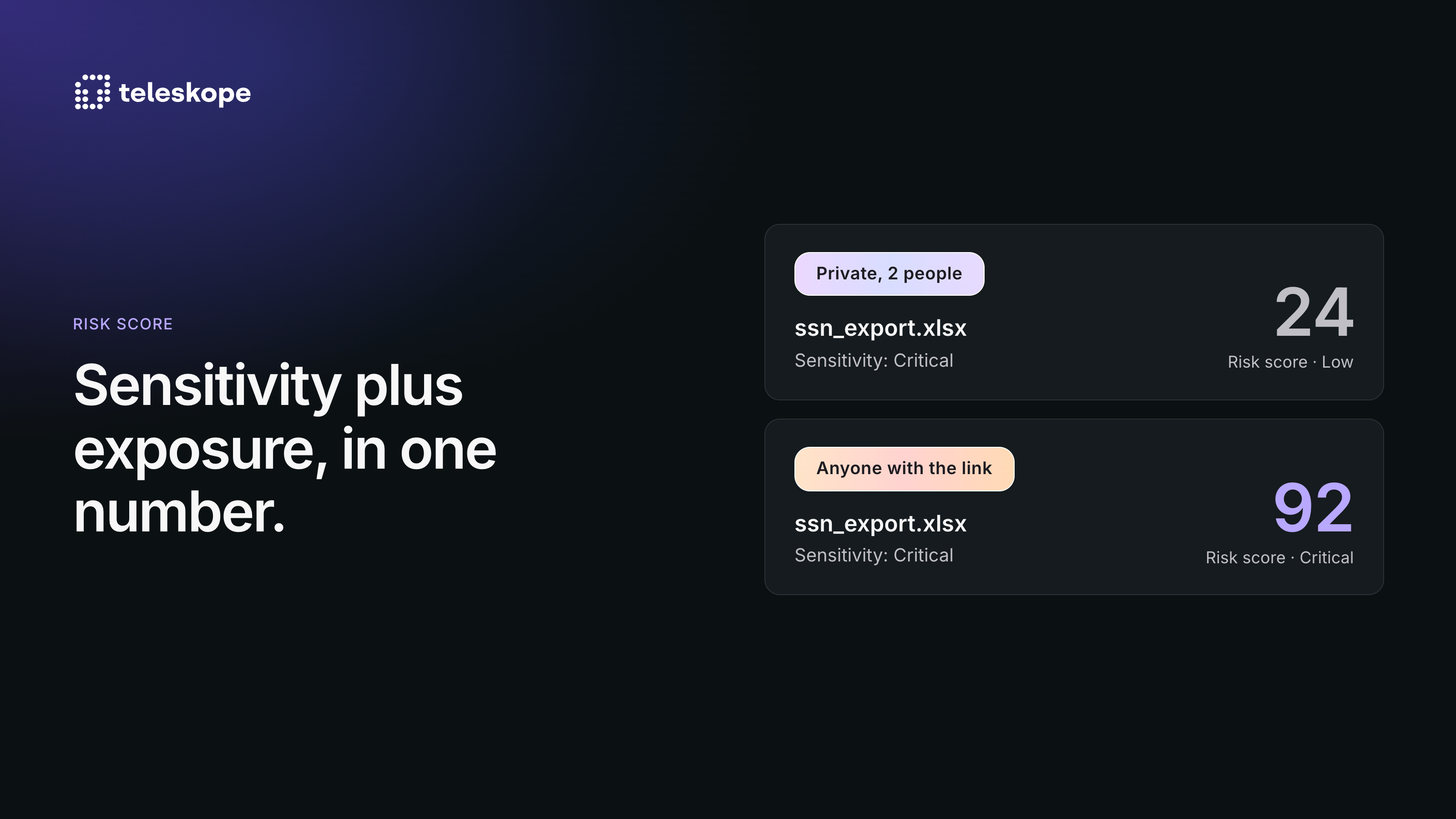
Classification needs context, not just pattern matching. A file containing Social Security numbers in a QA test environment and a production export with real customer records both match the same regex pattern but carry very different risks. Effective classification accounts for document type, data subject (customer vs. employee vs. test persona), business context, and storage location to produce findings that are actually prioritized by real-world impact.
Reduce the Attack Surface
Once you know where sensitive data lives, the next move is shrinking the number of ways it can be reached. Here is a practical, repeatable process for doing that systematically:
- Enforce least-privilege access: Right-size permissions to match current roles, removing standing access that was granted for projects that ended months ago.
- Revoke over-broad sharing: Eliminate domain-wide permissions and “anyone with the link” settings on files and folders containing classified data.
- Encrypt data at rest and in transit: Use strong key management and rotate keys on a defined schedule.
- Require MFA on every system that touches sensitive records: Make no exceptions for service accounts or internal tools.
- Harden configurations against known baselines: Use CIS Benchmarks, NIST frameworks, or similar standards, and monitor continuously for drift so that a change made at 3 pm on a Friday doesn't sit unreviewed until the next quarterly audit.
Sensitive Data Exposure Remediation That Closes the Gap
Sensitive data exposure remediation is the cycle of finding exposed data, judging the real risk in context, fixing it, and recording the action. It happens before incident response for a confirmed breach.
The metric that matters is time to risk reduction: the interval between discovering an exposure and remediating it. Alert counts and scan volumes tell you how busy the tool is. Time to risk reduction tells you whether risk is actually going down.
Context determines the fix. A publicly shared Google Doc with customer health records needs its link revoked immediately. A Slack message containing an API key needs redaction. A staging database with unencrypted PII needs access restriction and an owner assignment. One uniform rule (“alert the team”) doesn't work when the remediation actions are that different.
The gap most organizations struggle with is the distance between “found” and “fixed.” When every finding routes to a manual queue that depends on an analyst triaging it, prioritizing it, and then executing the right action, the queue grows faster than the team can work through it.
{{cs-1="/banners"}}
Policies That Enforce Themselves: From Rules on Paper to Automated Risk Reduction
Every organization has data-handling policies. The problem is that most of them live in PDF documents, wiki pages, or slide decks that no one references during actual work. The gap between “we have a policy” and “our policy is enforced” is where sensitive data exposure thrives. Closing that gap means encoding rules into systems that act consistently, without depending on someone remembering to follow them.
Encoding Data-Handling Rules Into Automated Workflows
The goal is straightforward: take the data-handling rules your organization already agreed on and wire them into automated workflows that execute every time. If the policy says “customer PII must not persist in Slack channels beyond 90 days,” the system should enforce that retention limit automatically. If the policy says “no production data in staging environments,” the system should flag and remediate violations as they appear.
What makes automated enforcement trustworthy rather than risky comes down to three things:
- Full audit trails: Every action needs a record so you can demonstrate exactly what happened and why.
- Reversible actions: A mistaken revocation should be undone without filing a support ticket and waiting three days.
- Human-in-the-loop review for ambiguous cases: Not every finding has a clear-cut answer, and context still matters.
How Teleskope Turns Policy Into Action
The problem described above is what Teleskope was built to solve. Rather than generating findings that route to a manual queue, Teleskope ties discovery directly to automated, auditable sensitive data exposure remediation. It revokes overly permissive links, redacts exposed PII in collaboration tools, enforces retention policies, and restricts what AI copilots can access, all based on policies you define. If you're wondering how to prevent sensitive data exposure at scale, this closed-loop approach is the answer: Detection and remediation happen in the same system, with no handoff delay.
The following table compares how traditional tools handle sensitive data exposure vulnerability versus how Teleskope approaches the same challenges:
Real results bear this out. Explore Teleskope's Data Exposure Prevention to see how Teleskope finds and remediates exposed data automatically, before it becomes a breach.
{{cs-2="/banners"}}
Conclusion
Sensitive data exposure is a problem that builds through accumulation, not through a single dramatic failure. It grows quietly through forgotten sharing links, overprivileged accounts, unmanaged copies of production data, and AI tools ingesting information that nobody intended to share. The organizations that avoid costly breaches are the ones that shrink the window between discovery and remediation nearly to zero. That requires continuous discovery, context-aware classification, and enforcement that runs without waiting for someone to clear a ticket queue.
Stop treating sensitive data exposure as a lesser version of a breach. Instead, treat it as the precondition for one. Audit your sharing settings, inventory your shadow data, govern what flows into AI tools, and measure your program by how fast risk actually decreases, not by how many findings you can generate. That gap between exposure and remediation is where breaches are born, and closing it is the most meaningful thing your security program can do.