


TL;DR: Amazon Elastic File System is one of the most widely used shared storage layers in AWS, powering everything from ML training pipelines to application logs to financial analytics workloads. Most organizations have no idea what sensitive data lives inside those file systems. Teleskope now discovers and classifies sensitive elements across your EFS volumes, giving security and compliance teams the same depth of visibility they already have for S3, Snowflake, and the rest of the modern data stack. If your organization runs workloads on EFS, you now have a clear answer when an auditor asks what sensitive data lives there.
EFS product release
Your Elastic File System Volumes Contain Sensitive Data. Now You Can Remediate It.
Shared file storage is one of the oldest patterns in enterprise infrastructure. The cloud version of that pattern, Amazon Elastic File System, inherited all the same properties: shared access across compute instances, a familiar NFS interface, and an assumption that the systems mounting the file system already know what they are doing with the data inside.
That assumption has not aged well.
Today's EFS volumes host a far wider range of workloads than the file servers of a decade ago. Machine learning teams mount shared volumes to feed training pipelines. Application teams write configuration files, logs, and generated reports to Elastic File System because it is easy to share across instances. DevOps teams use it as scratch storage during build and deployment workflows. In each case, sensitive data arrives quietly. Customer records embedded in a dataset. PII in a log file. Financial identifiers written out during a pipeline run. None of it is intentional. All of it real.
The problem is that standard security tooling does not reach into those volumes to find it. AWS's own encryption and access controls protect data at the infrastructure layer. They do not tell you what the data contains. Amazon Macie, the native sensitive data discovery service, scans S3. It does not scan EFS. The major DSPM platforms focus their discovery on object storage and databases, where most of the market attention sits. EFS falls through.
Teleskope now fills that gap.
{{banner-large="/banners"}}
What the Elastic File System Connector Actually Does for Security Teams
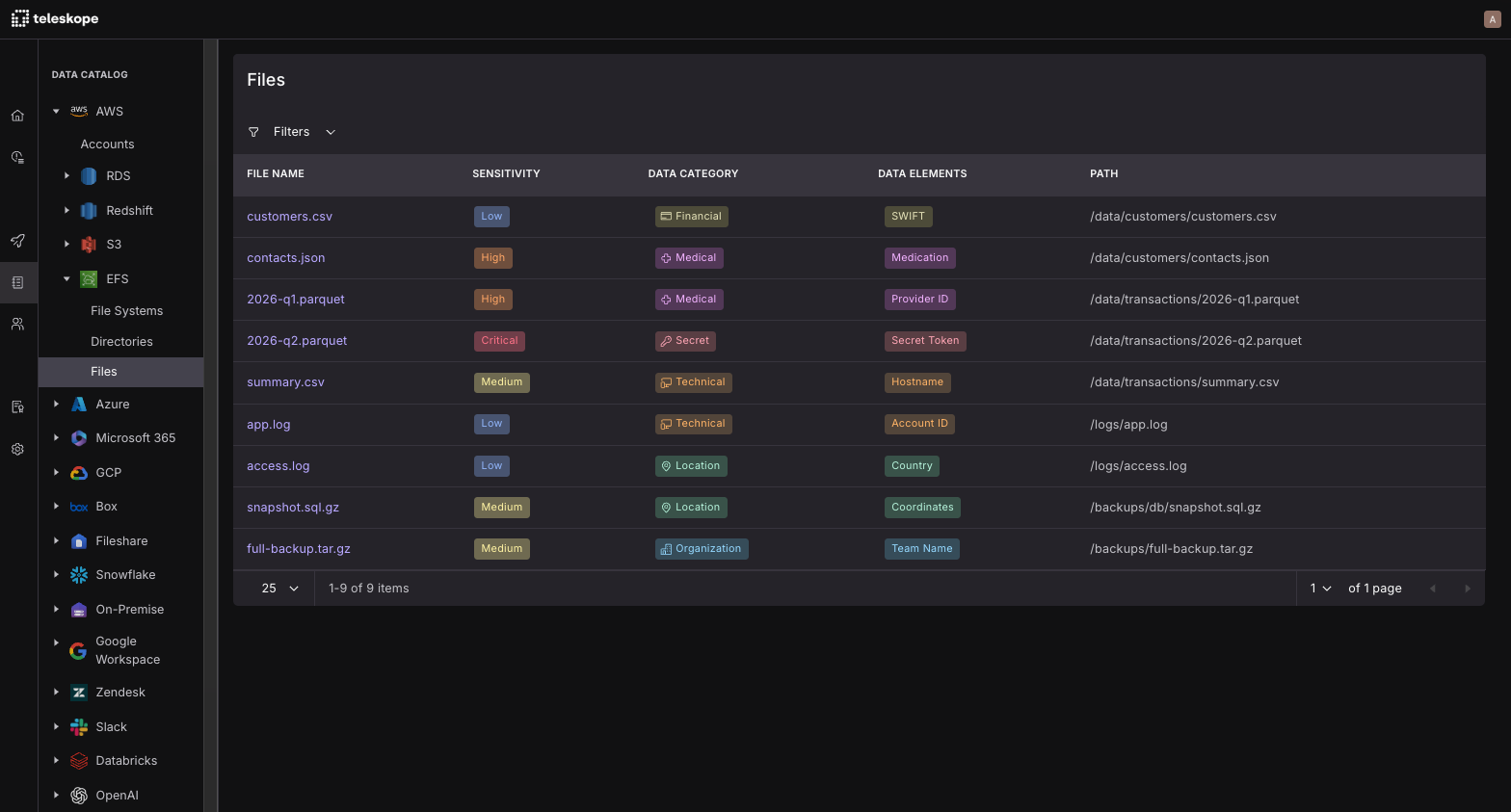
Teleskope discovers sensitive elements across your Amazon EFS file systems without requiring you to move, copy, or re-architect anything. The connector identifies PII, financial data, health information, credentials, and other regulated data types inside your volumes, and surfaces findings in the same unified catalog alongside your S3 buckets, Snowflake schemas, Slack workspaces, and every other data source Teleskope already covers.
That unified view matters. A finding in isolation tells you something. A finding correlated across your entire data landscape tells you what the actual risk is: where the same sensitive data appears, who has access, and whether your policies are being applied consistently.
For a security team running quarterly audits or preparing for SOC 2 or HIPAA assessments, the question is not just whether sensitive data exists somewhere in your environment. The question is whether you can demonstrate you know where it is and what controls apply to it. EFS has historically been a gap in that answer. It is not anymore.
{{cs-1="/banners"}}
Who Needs This
The organizations that benefit most from EFS-specific sensitive data discovery are the same organizations that run the most on EFS. That is not a trivial group.
Healthcare and life sciences organizations use EFS to store medical imaging pipelines, genomics datasets, and clinical application data. These workloads often involve PHI regulated under HIPAA, and the teams running them frequently move faster than compliance programs can track.
Financial services firms use Elastic File System for analytics workloads, algorithmic trading infrastructure, and reporting pipelines. The financial identifiers and customer data that flow through those pipelines are exactly what regulators expect organizations to account for under PCI DSS and GLBA.
Technology companies use EFS as shared scratch storage across large engineering teams. This is the environment where PII shows up in the least expected places: test datasets that were never sanitized, log files from production that were written to a shared volume for debugging, configuration files that include API keys or credentials.
For all of these organizations, the risk is the same. EFS is shared storage. That means any compute instance or application with the right network access can mount the volume and read what is inside. Without knowing what sensitive data lives there, you cannot make an informed decision about access controls, encryption enforcement, or data retention.
The Coverage Gap Your Current Tools Leave Open
Most DSPM platforms built their connector ecosystems around the data sources where enterprise data traditionally concentrates: object storage like S3 and Azure Blob, relational databases, and SaaS collaboration tools. That coverage reflects where the market focus was three or four years ago.
EFS is different. It sits closer to compute. It is mounted at the infrastructure layer, not accessed through an API like a SaaS tool or queried through a JDBC driver like a database. That architectural difference means most DSPM scanners were not built to reach it. Platforms like Cyera and Varonis do not include EFS-specific sensitive data scanning in their connector coverage. Niche AWS storage security tools like Cloud Storage Security do support EFS scanning, but those tools are not DSPM platforms. They do not correlate EFS findings with the rest of your data landscape. They do not surface the access and policy context that makes a finding actionable.
Teleskope's EFS connector is built natively into the same platform that covers your other 24 data sources. A sensitive file found on an EFS volume surfaces alongside the S3 objects, Snowflake tables, and Slack messages that Teleskope already classifies. Your security posture across your entire AWS environment becomes measurable in one place, not assembled from multiple point tools.
{{cs-2="/banners"}}
From Discovery to Remediation on EFS
Finding sensitive data is the first step. Knowing what to do about it is what drives actual risk reduction.
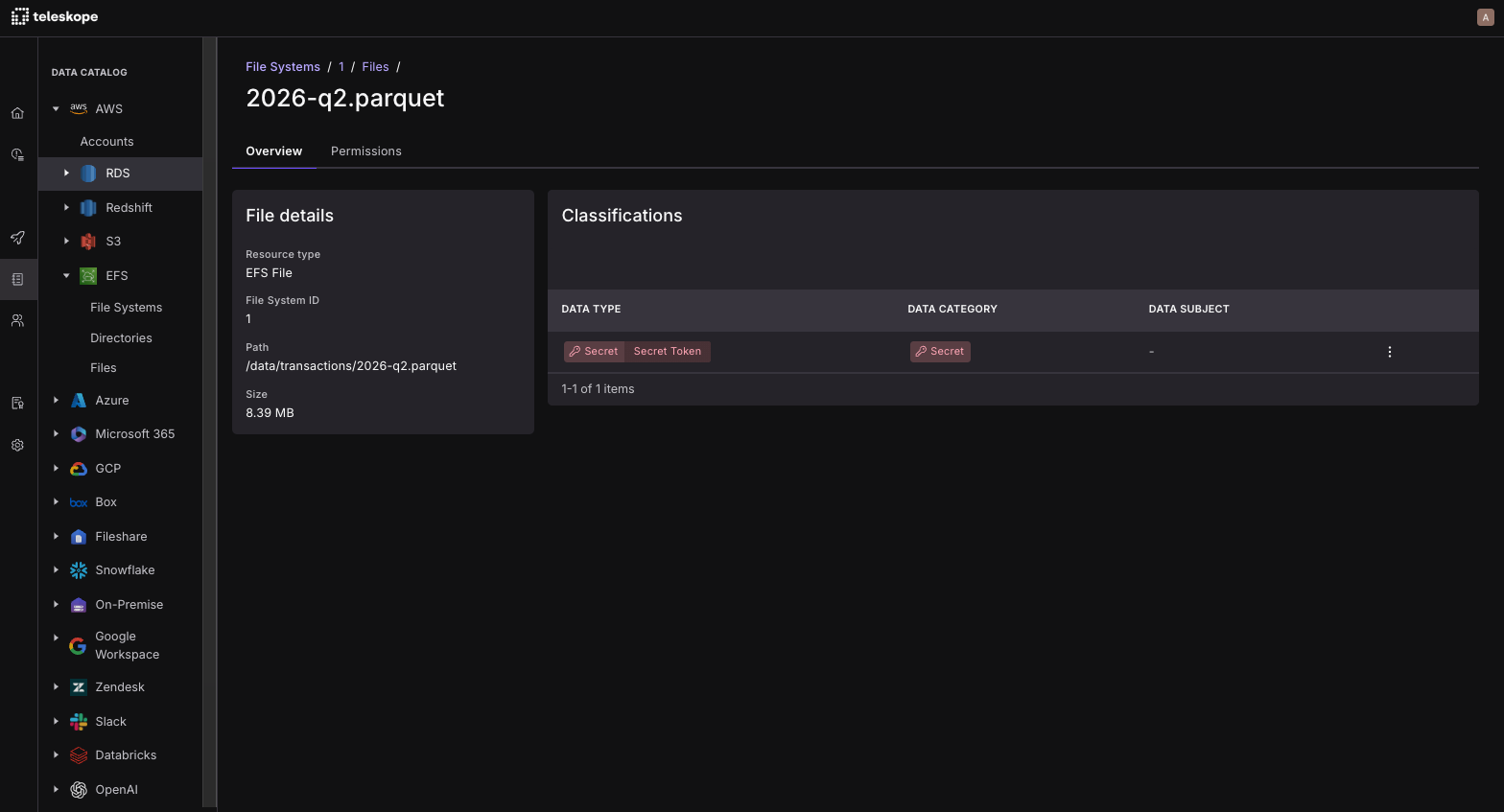
When Teleskope identifies a sensitive element on an Elastic File SystemEFS volume, it surfaces that finding in context. Which file system? Which path? What classification? What access controls exist on that volume? That context lets your team prioritize. A classified credential in a shared volume mounted by dozens of EC2 instances is a different risk than a single PII record in a development environment with restricted access.
From there, Teleskope's remediation workflows apply the same actions available across other connectors. Security teams can trigger alerts, route findings to ticketing systems, or apply automated remediation policies based on data classification and risk level. The Simulation and Dry Run capability lets teams preview the blast radius of any automated action before executing it, which is particularly important for shared file systems where a misconfigured policy could affect multiple workloads.
The goal is not a longer list of findings. The goal is a shorter list of open risks.
If you are running EFS in production and you do not have a clear answer to what sensitive data it contains, that is the gap Teleskope now closes.
To see the Elastic File System connector in your environment, book a call at teleskope.ai/book-a-call.




%20-%20Thumbnail_Wide.png)