


Introducing the Data Reasoning Layer
The first product in data security to combine classification, decision-making, and remediation in a single continuous loop. Live today.
The idea for Teleskope started while I was a security engineer at Airbnb. Sensitive data was accumulating, alerts were firing constantly, and the security team spent their days triaging tickets that mostly turned out to be business as usual.
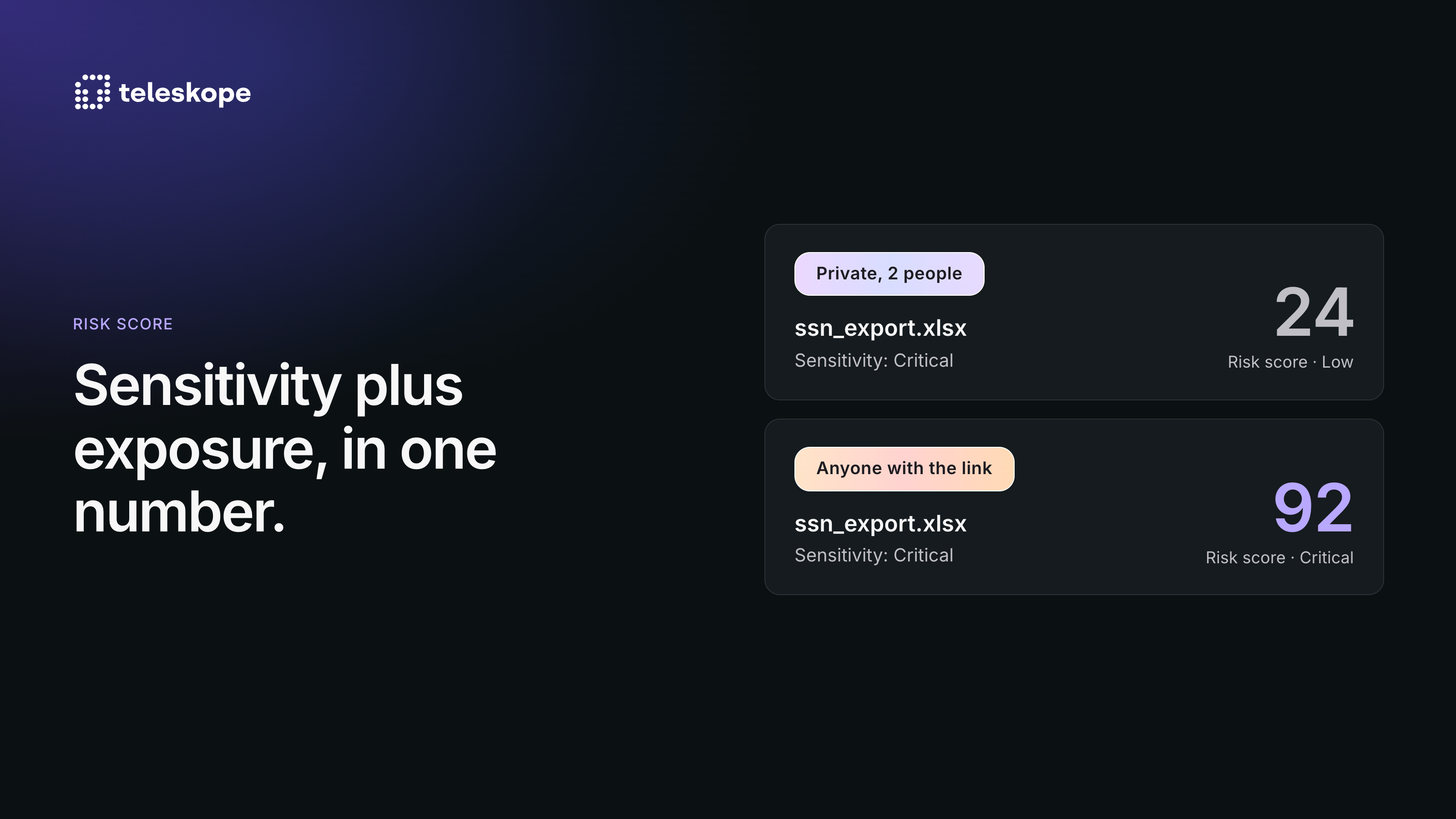
The hard part wasn't finding sensitive data. It was figuring out which exposure actually mattered and doing something about it. Every tool we had stopped at the alert.
I left knowing what was missing. Not another tool that found problems, but a platform that resolved them.
Today, we're announcing we're announcing the architecture that makes that possible: the Data Reasoning Layer.
It sits between finding sensitive data and acting on it. It understands the data in your business context, decides the right action based on policies you've already written, and enforces it in real time with human-in-the-loop controls. It's the first architecture in data security to connect classification, decision-making, and remediation in a single continuous loop.
{{banner-large="/banners"}}
What the Data Reasoning Layer is
The Data Reasoning Layer is the proprietary intelligence layer inside Teleskope that connects classification, decision-making, and remediation in a single continuous loop. It's the first architecture in the data security category to do this natively.
Three coordinated steps.
Understand. The Data Reasoning Layer identifies what each piece of data is in the context of your specific business, not against a generic pattern. It classifies more than 150 sensitive entity types and uses Prism, our document intelligence capability, to categorize full documents by type and intent rather than scanning for individual fields.
Decide. The Data Reasoning Layer determines the appropriate action based on your existing policies and risk profile. Available actions include inform, redact, quarantine, revoke access, relocate, encrypt, and delete. When confidence is low, the system routes to human review rather than acting incorrectly.
Enforce. The Data Reasoning Layer executes the action natively in the same session that found the risk. No ticket. No integration handoff. No human in the loop on high-confidence cases. Every action is logged, auditable, and reversible.
What's different about this
Every other platform in the data security category does one of two things. It surfaces findings (DSPM, data discovery), or it prevents data from leaving a defined perimeter (DLP). Neither category includes a decision-making layer that determines what to do about existing exposure and acts on that decision automatically. That's the gap we built the Data Reasoning Layer to fill.
Three things separate it from competing approaches.
Native remediation, not remediation by integration. When other platforms say "remediation," they mean one of two things. They send findings to a ticketing system for a human to process. Or they call an external SOAR platform via API. Both are handoffs. The exposure stays open while the ticket sits in a queue. The Data Reasoning Layer executes remediation in the same platform and the same session that classified the risk.
Business-context classification, not pattern matching. Regex, flat ML, and even BERT-based classifiers operate by matching data against known patterns. The Data Reasoning Layer builds a model of your specific environment and classifies based on business context, document type, and data relationships. This is what lets us identify a CEO's strategic plan or an M&A term sheet as board-level sensitive even when those documents contain no regulated data field.
A distinct decision layer. Other platforms either classify or enforce. None have a layer that sits between the two and makes context-aware decisions about which action is appropriate. The Data Reasoning Layer is that missing layer.
{{cs-1="/banners"}}
What's launching alongside
Four new capabilities are going live today that operate on top of the Data Reasoning Layer.
A new classification engine. Context-aware classification that goes beyond pattern matching, identifying what data is actually sensitive in your specific environment, not just what looks like a credit card number. Higher precision. Dramatically lower noise.
AI Search. Ask Teleskope a question in plain language and get an answer. "Show me all files shared externally that contain contract terms and haven't been accessed in six months." No query syntax. No analyst required.
Policy Builder and Policy Ingestion. Build policies from scratch or feed in your existing governance documents (retention policies, regulatory requirements, data handling frameworks) and watch them become enforceable workflows automatically.
Automated remediation across OpenAI, Slack, and Claude. Sensitive data detected and resolved in real time in the environments where exposure happens most. In under two seconds. Without a ticket filed or a human in the loop. Teleskope is one of four OpenAI-approved partners for conversation message logs in the OpenAI Logs Platform.
What customers are seeing
The math changes the moment classification is accurate enough to safely automate and remediation is native to the platform that found the risk.
Customers using the Data Reasoning Layer see approximately 10x faster time to risk reduction. Up to 15 percent cost savings from freed security resources and storage optimization. Sub-two-second response time for sensitive data exposure in AI environments. False positive rates that don't require a six-month tuning project before the platform can be trusted at scale.
The bigger change is qualitative. Aprio's 10-person security team supports more than 4,000 employees through six automated policies in production, feeding Microsoft Purview's DLP engine through MIP labels. EarnIn protects millions of fintech customers through self-service auto-remediation governed by a Policy Builder. Alloy applies automated response across hundreds of financial institution customer environments, with full data residency control through a self-hosted deployment. Zomato classifies 30GB of data in 9 hours across DynamoDB, MongoDB, MySQL, and third-party event logs in a 100 percent automated pipeline.
Security teams stop being firefighters. They start setting policy and confirming the system is enforcing it. That's a different job. It's the job the field was supposed to be.
{{cs-2="/banners"}}
Why now
The capability conversation in AI is moving faster than the access control it depends on. Every AI integration multiplies the locations where sensitive data flows. Every copilot, every agent, every MCP server is a new path for sensitive data to spread.
The platforms that win the next chapter of data security won't be the ones with the most detections. They'll be the ones whose architecture connects detection to enforcement automatically and continuously.
The Data Reasoning Layer is that architecture.
— Lizzy Namour, founder and CEO of Teleskope