TL;DR: AI data loss prevention (AI DLP) keeps sensitive content out of prompts, copilots, and agents by classifying data on business context rather than pattern matching. It governs what assistants can retrieve, what models train on, and what sits in old AI conversation logs. Controls sit in the browser, endpoint, AI gateway, MCP layer, or platform APIs, and all depend on classification at the source. Traditional DLP misses prompts, so the capabilities that matter are document-level classification of IP, native remediation in the same session, reversible actions with human review, and audit trails that satisfy the EU AI Act and ISO 42001.
Someone on your team pasted a client contract into an AI assistant this week, but you’ll probably never hear about it. The file was never labeled, your DLP rules never fired, and the content now sits in a query that left your environment. Prompts leave no attachment to scan and no file to classify. Most controls in your stack were built for email, not chat boxes.
Teleskope's Alert-to-Remediation Gap report found that 70% of firms now rank AI data exposure or sensitive data sprawl as their top risk for the next 12 months. Half still call remediation mostly or fully manual. That combination is why AI DLP matters. Below, you will see what AI data loss prevention actually requires, which capabilities separate real DLP for AI from rebranded regex, and how to evaluate AI DLP solutions before you sign anything.
What AI DLP Is and Why Traditional Controls Miss the Mark
Before you can govern how your teams use AI, you need a clear definition of what you are actually buying. The category is crowded with rebranded rule engines wearing new labels, so it helps to separate what AI data loss prevention actually does from what your existing controls were built to handle.
From Pattern Matching to Context: A Working Definition of AI DLP
AI DLP stands for AI data loss prevention. It covers the controls that keep sensitive data out of generative AI tools, copilots, and agents and that govern what those systems are allowed to read, retain, and train on.
AI DLP classifies content by what it means in your business, determines the appropriate action, and enforces that action inside the AI workflow itself.
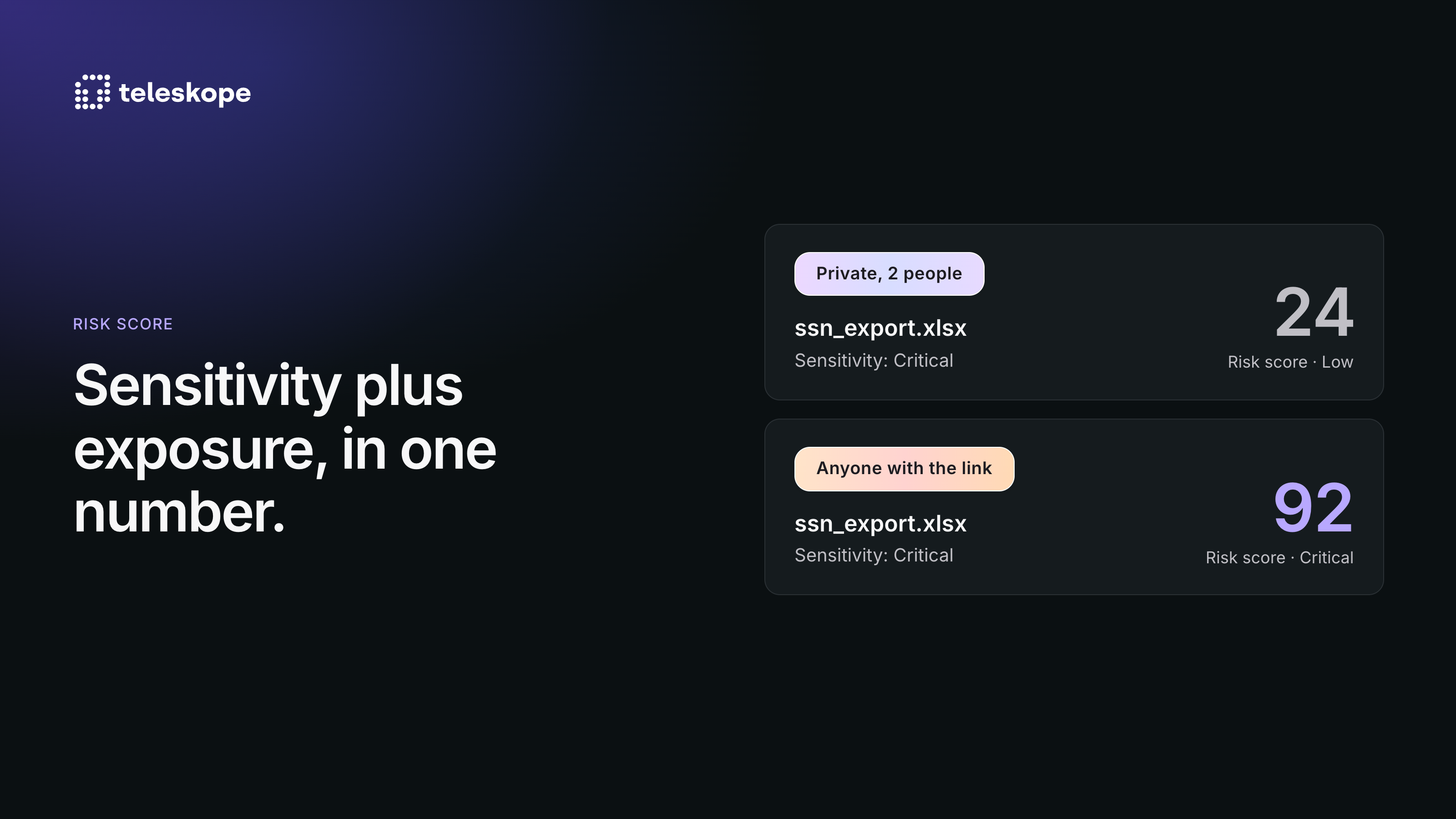
The real difference from older tooling comes down to context. A regex can find nine digits in a 1099 form but cannot tell you that the same nine digits sitting in an engineer's shared folder are a problem or that an unsigned M&A term sheet with no regulated field anywhere in it is still board-level sensitive. That judgment is exactly what DLP for AI workloads has to supply because the data no longer moves through a channel you can inspect.
Where Classic DLP Breaks the Moment a Prompt Leaves the Building
Traditional DLP watches channels: email gateways, endpoints, and managed file transfers. A prompt is none of those. There is no attachment to scan, no recipient domain to check against a blocklist, and usually no label attached to the pasted text because nobody ever labeled the source document in the first place.
Copilots break the model from the opposite direction. They inherit the permissions of whoever is asking and then surface years of ungoverned files that technically everyone could always reach but nobody ever found. Channel controls have nothing useful to say about that, which is why enforcing least privilege access becomes a prerequisite rather than a nice-to-have. Teleskope treats permission sprawl and classification as one problem, not two separate projects.
The Terms Worth Knowing: Shadow AI, Prompt Leakage, Copilot Blast Radius
Three terms come up in nearly every AI governance conversation, and each one names a distinct risk you will need to answer for when evaluating AI DLP solutions:
- Shadow AI: Unsanctioned AI tool usage by employees, which spreads through an organization faster than any review process can process the requests.
- Prompt leakage: Sensitive content entering a model's context window or retention logs through ordinary, well-intentioned day-to-day queries.
- Copilot blast radius: The volume of sensitive data an internal assistant can reach through inherited access and years of overly permissive sharing.
Is AI DLP the same as a CASB? No. A CASB governs which cloud applications people are allowed to use. AI DLP governs the data itself, whichever application it eventually lands in. If you are currently trying to stretch a legacy suite across this gap, it is worth reading why teams are replacing Microsoft Purview instead of extending it.
{{banner-large="/banners"}}
Where to Deploy AI DLP Controls, From the Browser to the MCP Layer
AI DLP is not one product in one place. Data reaches models through browser tabs, desktop apps, API calls, and agents, and each path has its own enforcement point that sees a different slice of the traffic.
Browser Extensions for Web-Based AI Tools
An extension reads what users type or paste into ChatGPT, Claude, or Gemini and can block, redact, or warn before the prompt is sent. It only covers managed browsers, so desktop apps, mobile apps, API traffic, and personal laptops go around it.
Endpoint Agents and Network Proxies
Endpoint agents cover desktop AI apps, the clipboard, and file uploads. SSE proxies block traffic to unsanctioned AI domains. Proxies need TLS decryption, which breaks on certificate pinning, and both miss unmanaged devices and are only as good as the classification behind them.
AI Gateways for Internal Apps and Model APIs
Apps your engineers build on OpenAI, Anthropic, or open-source models send prompts straight from code to a model endpoint. An AI gateway in that path masks sensitive fields in requests and checks responses, but only for traffic routed through it.
The MCP Layer for Agents and Tool Calls
Agents pull data out of your systems through tool calls, often via MCP servers connected to Google Drive, SharePoint, or Salesforce, and whatever comes back lands in the model’s context window. Controls here decide which MCP servers are approved, which tools each agent can call, and what each tool can return. Teleskope pairs with MintMCP for this layer, as covered in this breakdown of enterprise AI agent security.
API Integrations With the AI Platforms Themselves
Enterprise AI tools usually expose admin or compliance APIs. Connecting there lets a platform read prompts, uploads, and history inside ChatGPT Enterprise, Claude, Slack AI, or Notion with no decryption, including conversations from before any control existed. Teleskope connects to AI platforms this way.
The Data Source Underneath Every Other Control
Every control above is only as accurate as its classification. Classifying data where it lives gives every layer the same answer about what is sensitive and shrinks what copilots and agents can reach. Most teams run two or three of these controls together, and this is the layer the rest depend on.
{{cs-1="/banners"}}
The Capabilities That Separate Real DLP for AI from Repackaged Rules
Plenty of vendors bolted an “AI” tab onto an existing console last year and called it a product launch. But that tab usually does just one thing: block a list of domains. It stops nothing because the same employee can open a personal account on their phone and the work continues, now completely outside your visibility.
Here is what actually has to be true for AI DLP to change outcomes instead of just adding another dashboard nobody opens.
Context-Aware Classification of Prompts, Uploads, and Attachments
Pattern matching fails in AI workflows for a boring reason: most of what gets pasted into a chat window has no pattern to match. Pricing models, board deck excerpts, and customer escalation threads with names and account details are examples of things regex doesn’t find. It does, however, fire an alert on a 1099 form that is supposed to contain a Social Security number and sits in the exact folder where it belongs.
Context-aware classification asks different questions: What is this content, where did it come from, who touched it, and is its presence here expected? An SSN inside a payroll document is unremarkable, but the same string inside a prompt headed to an external model is a policy event. Drawing that line requires a classifier that understands the environment it runs in, not a dictionary of entity types applied uniformly to every file it meets. Teleskope's approach to PII data classification works this way by design.
Ask any vendor to run their engine against your weirdest data before you sign anything: customized Salesforce objects, a homegrown CRM with column names nobody documented, or a data lake that looks nothing like the demo environment. Precision and recall on clean test data tell you nothing about what happens on a Tuesday morning inside your actual tenant.
Document-Level Understanding for IP That Contains No Regulated Field
Here is where most DLP for AI quietly gives up. Your most valuable document may contain zero regulated fields. A proprietary synthesis process representing a decade of R&D has no credit card number in it. A draft M&A term sheet has no PHI. A CEO's strategic plan has nothing a classifier was trained to recognize. An attacker reading any of those would know within seconds what they were worth. Your DLP tool would not.
Document intelligence classifies a file by what it is, not by which fields it happens to hold. That means recognizing a sealed legal case, an unreleased product spec, or a contract still in negotiation based on structure, language, and business context. It also means catching the inverse: test data stuffed with realistic-looking account numbers that should never generate an incident at all.
If your classifier can only find data that matches a pattern, your intellectual property is invisible to it, by definition.
Governing What Copilots and AI Agents Can Actually Reach
External chatbots get the headlines, but internal copilots create a larger blast radius. When Microsoft 365 Copilot or an internal agent inherits a user's permissions, it inherits every over-permissioned share that piled up across a decade of onboarding shortcuts. A finance analyst who was never supposed to see HR files can now ask a plain-English question and get a tidy summarized answer pulled straight from them. Nobody breached anything; the access was always there, just too tedious for a human to exploit at scale.
Governing copilot reach means mapping what each agent can retrieve based on data sensitivity, then tightening it before rollout rather than after the first incident. Agent identity is becoming its own control discipline. Authorization has to be evaluated against the resolved identity and the payload classification together. Every tool call that an agent makes needs its own decision, not a single approval at invocation. A service account with blanket model access satisfies nobody's auditor.
Controlling What Models and Agents Train On
Fine-tuning a model on a dataset that contains PII nobody knew was there is a one-way door. You cannot un-train a model. You can retrain it, expensively, assuming you ever discover the problem. This is why AI data loss prevention has to sit upstream of the training pipeline instead of downstream of the output.
The control that matters is dataset-level: knowing exactly which sensitive elements live inside a training corpus before it reaches the pipeline, and blocking or masking them at that point. The same logic applies to retrieval-augmented systems, where the vector store becomes a second copy of your sensitive data carrying none of the original access controls.
Native Remediation Instead of Another Alert Queue
This is the line that separates AI DLP solutions worth evaluating from the rest. A tool that detects a sensitive prompt and files a ticket has moved risk from one queue to another. The prompt has already left, and the link is already public. Detection without enforcement produces a longer to-do list and a team that learns to scroll past it.
Native remediation means that the action happens in the same session as the detection, inside the same platform, with no integration handoff and no human in the path for high-confidence cases. Block the transfer, revoke the link, and redact the credential in the channel. The practical test during evaluation is simple: count how many systems have to cooperate between “found” and “fixed,” and how many minutes that chain takes. Teleskope makes the case for why automated remediation is the future of data security in more depth.
Cleanup and Governance of Historical AI Conversations
Every organization that adopted AI tools before adopting AI controls is carrying a backlog. Months of conversation history sitting in ChatGPT workspaces, Claude projects, Slack AI threads, and Copilot chat logs, holding whatever employees pasted in during that unsupervised window. Most teams have never looked.
Governing that history means scanning past conversations the same way you scan a shared drive, then applying retention and deletion policy to whatever turns up. It also means answering the question your legal team will eventually ask: if a data subject request or a litigation hold arrives, can you say what personal data lives in your AI conversation history? Under GDPR, a chat log holding personal data is personal data regardless of the interface it arrived on.
Audit Trails That Hold Up Under the EU AI Act and ISO 42001
Board members are asking about AI governance now, and “we blocked ChatGPT” does not survive the follow-up question. What survives is evidence: what was found, why it was classified as risky, what action fired, under which policy version, and who had the ability to override it.
Both the EU AI Act and ISO 42001 expect meaningful human oversight of automated decisions. In practice, this means an append-only record that an external reviewer can reconstruct without your team narrating it line by line. Build for that record from day one. Retrofitting an audit trail after eighteen months of enforcement is a project that nobody has budget for.
Reversible Actions and Human Review for Low-Confidence Calls
The honest objection to automated enforcement is fear of a wrong call at scale, and it is a fair fear. A confident misclassification that quarantines a live customer file causes more damage than a missed finding sitting in a review queue.
Two design choices resolve this. First, actions should be reversible, with quarantine periods before anything is permanently removed, so a mistake costs an hour rather than a dataset. Second, the system should abstain when confidence drops, routing the edge case to an analyst with full context instead of forcing an answer it cannot defend. A classifier that knows the limits of its own certainty earns far more trust than one that never hesitates.
How to Roll Out AI Data Loss Prevention in Five Steps
Knowing what good looks like is one thing. Getting it running in an environment that already has a ticket queue, a Purview deployment, and a copilot rollout scheduled for next quarter is another problem entirely. The sequence below is the one that security teams keep landing on, and the reason is simple: it earns trust before it asks for autonomy.
Crawl, Walk, Run: A Deployment Sequence That CISOs Actually Trust
Each of these five steps depends on the one before it, so resist the urge to jump straight to enforcement. Here is the order that holds up under scrutiny:
- Map where AI touches your data: Pull sign-in logs from your identity provider (Okta, Entra ID) to surface unsanctioned tools, then list every sanctioned surface: Microsoft 365 Copilot, ChatGPT, Claude, Slack AI, Notion AI, and any internal agents your engineering team stood up quietly last sprint.
- Classify before you enforce: Build the data map across cloud, SaaS, and on-prem stores, then validate the results on your own messiest systems instead of a tidy sample set. Incorrect classification automated at scale is worse than no automation at all.
- Turn written policy into enforceable rules. Feed your existing retention schedule and data governance framework into the platform, then define three buckets: actions permitted automatically, actions requiring confirmation, and actions never automated under any circumstance.
- Automate one narrow use case with a human in the loop. Credentials posted in collaboration channels and public links on client folders are the usual starting points because the finding is unambiguous and the action is reversible.
- Expand scope and review the audit trail monthly. Once accuracy holds steady, widen enforcement and reserve analyst attention for low-confidence edge cases and documented exceptions.
Sequenced this way, your team accumulates evidence of correct decisions before anything runs unattended. That evidence is exactly the argument you will need when someone asks why automation was allowed to touch production data.
Comparing AI DLP Solutions: What to Test Before You Sign
Run the proof of concept in your own tenant, on your own data, with your weirdest repository included on purpose. Ask which control points the product covers natively, and whether it needs TLS interception or inspects content through APIs at the source. Decryption breaks on certificate pinning and unmanaged devices, which is why source-level classification is the stronger foundation.
Use the table below as a scoring sheet during the pilot, testing each capability against your environment rather than the vendor's demo tenant.
If a vendor resists testing on your messy data, treat that as the answer. The gap between AI DLP that works on a curated dataset and AI DLP that survives your production environment is where most disappointing renewals begin.
Metrics That Prove Risk Reduction to Your Board
Four numbers travel well upstairs: median time from detection to closure, the share of findings resolved without a person touching them, the age of your oldest open high-priority finding, and the count of sensitive assets reachable by AI tools this month versus last. Track hours returned to the team alongside them because that is the number that turns into a budget conversation.
Organizations using AI and automation extensively in security saved an average of USD 1.93 million on breach costs compared to those using none. (source)
Report the trend line rather than a single snapshot. A backlog that shrinks month over month tells a board more than any dashboard screenshot, and the same chart holds up when a regulator asks the identical question a year later.
{{cs-2="/banners"}}
How Teleskope Resolves AI Data Exposure Automatically
Everything described so far covers what AI DLP is supposed to do. The harder question is what happens in the minutes, hours, or weeks between the moment sensitive content gets detected and the moment the exposure actually closes. Most tools hand that gap to your team as a queue. Teleskope was built to close it inside the same session.
The Data Reasoning Layer: Understand, Decide, Enforce
The Data Reasoning Layer runs three coordinated steps in a continuous loop.
Understand builds a model of your data from your data, using a hierarchical multi-head classification architecture that delivers over 10% higher precision and over 38% higher recall than flat classifiers across 150+ entity types. Prism, the document intelligence capability, classifies whole documents instead of hunting for individual fields buried inside them.
Decide picks the action that fits the profile: inform, redact, quarantine, revoke access, relocate, or delete. Your existing retention and governance policies are ingested as input, so enforcement reflects the rules your team already wrote rather than a vendor's defaults. When confidence drops below threshold, the system abstains and routes the finding to an analyst with full context attached.
Enforce acts natively. No ticket, integration handoff, or waiting on another team's sprint. Every action is governed, auditable, and reversible, following a crawl, walk, run sequence you control at every stage.
Sensitive data exposure in AI environments like OpenAI, Slack, Notion, and Claude is resolved in under two seconds.
Six Exposure Scenarios That Teleskope Closes Without a Ticket
These six situations come up on nearly every first call. Here is what resolution actually looks like in each one:
- A contract pasted into an AI assistant: Teleskope classifies the document at the source and blocks the transfer because the content is sensitive, not because someone remembered to label it months earlier.
- A plain-text password in Slack from eighteen months ago: The content is detected and removed automatically, with the relevant team notified.
- A client folder set to “anyone with the link”: The link is revoked before the finding ever reaches a human queue.
- Client records from accounts closed fourteen years ago: Retention policy applies and data is quarantined for a recovery window and then deleted with a full audit trail.
- A proprietary synthesis process with no regulated field in it: Classified as critical IP based on what the document means to your business.
- Thirty-one users who have not touched a financial shared drive in 90 days: Access is removed and non-use evidence logged.
Each of these starts with accurate discovery, which is why classification quality determines whether automated enforcement is safe to turn on at all.
Where Teleskope Fits Alongside Purview, DSPM, and Your Existing Stack
Teleskope is additive. Accurate classification feeds MIP labels into Microsoft Purview, improving its enforcement instead of standing up a parallel system that competes with it. Deployment is agentless, so there is nothing to push to endpoints.
The table below compares how detection-first tooling and Teleskope handle the same four decisions, which is where most AI DLP solutions diverge in practice.
That difference in the second row is the whole argument for AI data loss prevention that enforces rather than reports. An alert is a description of a problem you still have; native remediation is the problem being gone. If you are evaluating DLP for AI, ask every vendor what happens in the 90 seconds after detection and compare the answers.
Want to see it run against your own environment? Book a call.
Conclusion
Nobody gets to pencil AI adoption into next quarter's roadmap. It is already running inside your organization, in browser tabs and copilot sidebars that never went through review, and the data moving through those tools was poorly governed long before anyone typed a prompt. So the work starts below the AI layer instead of at its edge: figure out what your sensitive content actually consists of, decide what should happen the moment it lands somewhere it doesn't belong, and let enforcement finish the job without waiting for someone to open a ticket. That underlying discipline is what makes AI DLP useful rather than decorative.
Take one exposure you already know about, like credentials parked in a collaboration channel or a client folder shared with anyone who has the link, and time how long it takes to actually resolve today. That number is your baseline. Run any AI data loss prevention tool against it in your own tenant, messiest repository included, and watch whether the distance between found and fixed shrinks. Plenty of AI DLP solutions look strong in a demo environment and stall the second real content enters the picture, which is exactly why DLP for AI deserves testing on your worst data rather than someone else's sample set.