


Your team probably finds vulnerabilities faster than it can fix them. Discovery tools flood dashboards with alerts while sensitive data sits exposed in Slack channels, overly permissive Google Drive folders, and forgotten S3 buckets. The gap between detection and resolution is where breaches actually happen. This is why automated vulnerability remediation has become non-negotiable for security teams held accountable for outcomes, not just awareness.
This guide covers how vulnerability remediation automation works in practice, where it genuinely outperforms manual processes, and where human judgment still matters. You'll get a step-by-step implementation framework, a clear comparison of automated versus manual approaches, and an honest look at what tools need to deliver before they earn your trust.
What Is Automated Vulnerability Remediation?
Automated vulnerability remediation is the practice of using policy-driven technology to identify, prioritize, and fix security vulnerabilities without requiring a human to manually execute each step. Instead of generating a list of problems and handing it off to an already stretched team, the system takes direct action by revoking overly permissive access, redacting exposed sensitive data, purging stale files, or enforcing least-privilege policies based on rules your organization defines.
Why Manual Remediation No Longer Scales
Think about how your team actually handles a finding. Someone discovers a publicly shared Google Drive folder containing customer PII. A ticket gets created and sits in a queue. An analyst reviews it, confirms the risk, determines the right fix, coordinates with the data owner, and eventually revokes the link. That cycle might take days or weeks for a single folder. Now multiply that by hundreds of similar exposures across Slack, Teams, AWS buckets, and Zendesk tickets.
The math just doesn't work. According to VulnCheck's 1H-2025 exploitation analysis, 32.1% of known exploited vulnerabilities had evidence of exploitation on or before the day the CVE was disclosed, up from 23.6% in 2024. When exploitation happens at disclosure speed, manual processes are structurally incapable of keeping pace.
Automated vulnerability remediation replaces the “find it, file it, forget it" cycle with policy-driven enforcement that resolves risk the moment it's detected.
How Vulnerability Remediation Automation Actually Works
Vulnerability remediation automation follows a straightforward logic chain:
- Continuous scanning discovers and classifies sensitive data or misconfigurations across your environment: cloud storage, SaaS platforms, databases, and collaboration tools.
- The engine evaluates each finding against your defined risk policies: What data is involved? Who has access? Is the exposure public or internal?
- The system executes a remediation action: redacting the exposed data, revoking the link, encrypting the file, or deleting it entirely. This step is where most tools stop,
The critical distinction is that every action remains auditable and reversible. You're not handing a black box full authority over your infrastructure. You're defining the rules, setting confidence thresholds, and choosing where full automation runs versus where human approval is required. That's what separates trustworthy automated vulnerability remediation tools from reckless ones.
{{banner-large="/banners"}}
Automated vs. Manual Vulnerability Remediation
Knowing what automated vulnerability remediation is and why it matters is one thing. Deciding where to draw the line between automation and human involvement is another. Let's break down the actual performance differences and the scenarios where each approach earns its place.
Speed, Accuracy, and Resource Cost Compared
The contrast between automated and manual remediation is structural. When a sensitive file gets shared externally through a misconfigured Google Drive link, an automated system can revoke that access within seconds. With a manual workflow, you're looking at ticket creation, analyst review, data-owner coordination, and execution. Each handoff introduces delay, and each delay extends exposure.
According to Hadrian's 2026 Offensive Security Benchmark Report, high-severity vulnerabilities take an average of 139 days to fix. That's a window of opportunity for attackers that stays open for nearly five months.
Here's how the two approaches compare across the dimensions that actually matter to security leaders.
| Dimension | Automated Remediation | Manual Remediation |
|---|---|---|
| Time to resolution | Seconds to minutes after detection | Days to weeks, depending on queue depth |
| Consistency | Identical policy enforcement every time | Varies by analyst judgment and workload |
| Analyst hours per 1,000 findings | Near-zero for policy-matched cases | Hundreds of hours across triage and execution |
| Audit trail | Auto-generated, complete, and timestamped | Depends on documentation discipline |
| Error rate at scale | Low: bounded by policy accuracy | Increases under alert fatigue and time pressure |
| Best suited for | Repeatable, high-volume, well-defined risks | Ambiguous, context-heavy, or politically sensitive decisions |
The resource cost difference hits especially hard for lean teams. Every hour an analyst spends revoking a public link or deleting stale PII from a support platform is an hour not spent on threat modeling, incident response planning, or evaluating third-party risk. That trade-off adds up fast when you're processing thousands of findings per quarter.
Where Automation Fits and Where It Doesn't
Vulnerability remediation automation tools shine brightest on the repetitive, high-confidence actions that eat up your team's calendar. Whether it’s revoking domain-wide sharing on a file containing PCI data, purging expired sensitive records that violate your retention policy, or redacting exposed PII in a Slack channel before it propagates, it can all be automated.
Where you want a human in the loop is when context gets messy. A shared folder flagged as overly permissive might actually be a cross-departmental workspace approved by legal. A dataset marked for deletion could be under a regulatory hold. These edge cases demand judgment that no policy engine can fully replicate, yet. Strong data access governance helps reduce ambiguity, but some decisions still need a person behind them.
The goal isn't to remove humans from the process. It's to stop wasting them on tasks that a well-configured policy can handle in milliseconds.
The strongest implementations use a tiered model: full automation for high-confidence, low-ambiguity findings, and human approval gates for anything that touches nuanced business logic or regulatory gray areas.
{{cs-1="/banners"}}
5 Steps to Implement Vulnerability Remediation Automation Tools
Knowing that automation beats manual work is the easy part. The harder question is: How do you actually roll this out without breaking things or losing the trust of your team? Here's a concrete implementation path that treats vulnerability remediation automation as an engineering discipline.
Step 1: Build a Continuous Discovery and Classification Foundation
You can't remediate what you haven't found. Before any automation logic kicks in, you need a scanning engine that continuously discovers sensitive data and misconfigurations across every environment your organization touches: cloud storage, SaaS platforms, databases, collaboration tools, all of it. A one-time audit won't cut it because data changes constantly.
Your foundation has to be a living, continuously updated data map that classifies what it finds with high enough accuracy that your downstream policies don't fire on garbage. If your data classification accuracy is poor, every automated action built on top of it inherits that weakness.
Step 2: Prioritize Vulnerabilities by Real-World Risk
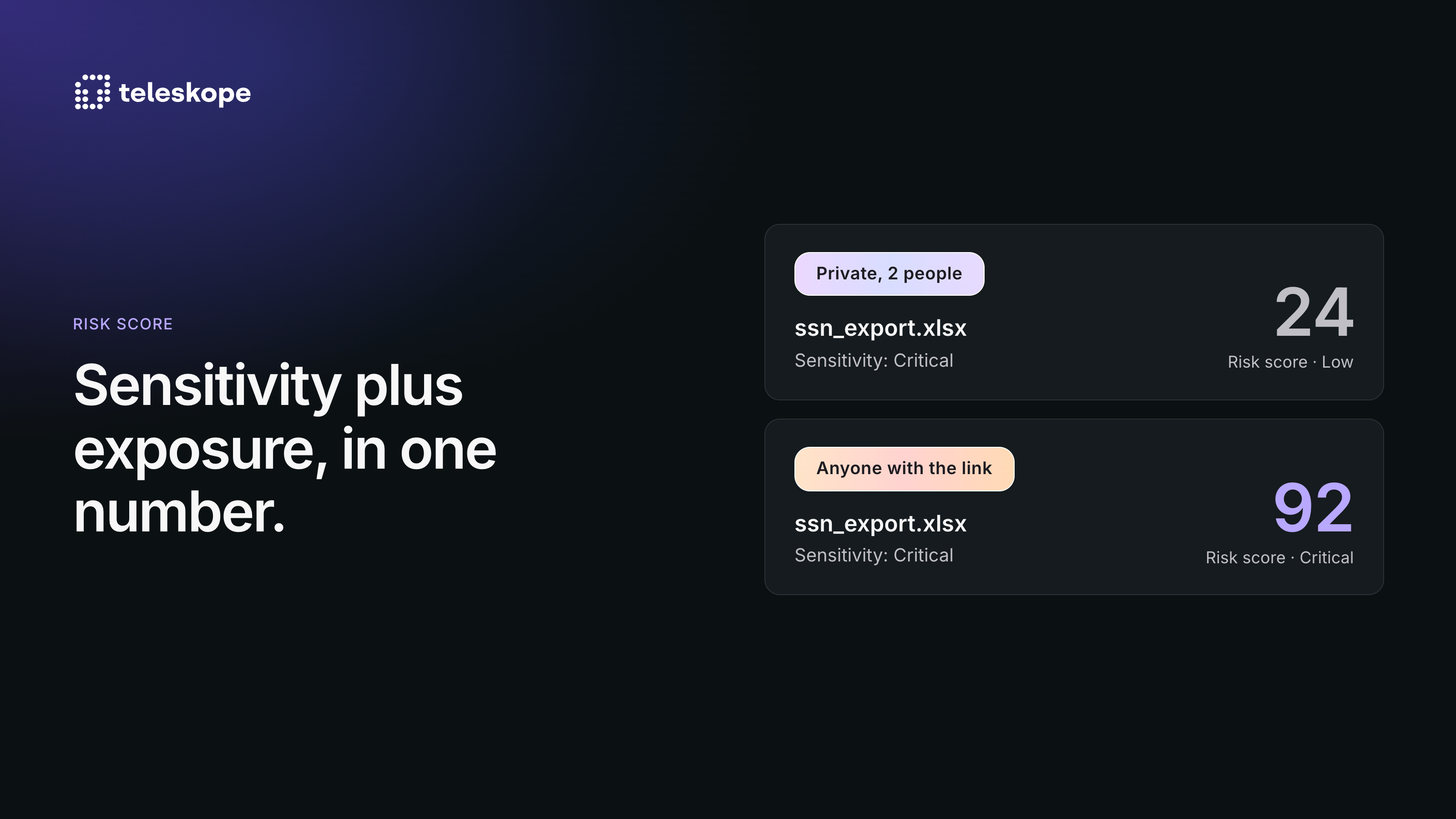
Not every finding deserves the same urgency. A publicly shared folder containing test data is a different problem than a publicly shared folder containing customer Social Security numbers. Effective vulnerability remediation automation tools score findings based on data sensitivity, exposure scope (internal vs. external), access patterns, and regulatory context.
This step keeps your automation from treating a minor misconfiguration the same way it treats an active data leak. Without prioritization, you either automate everything indiscriminately, creating noise and operational friction, or you hesitate and automate nothing. Neither outcome is acceptable when you're responsible for protecting sensitive data at scale.
Step 3: Define Auditable Remediation Policies
Each policy should specify the trigger condition, the action to take, and the audit trail it produces. For instance: “If a file classified as PCI is shared via a public link, revoke the link and log the action with a timestamp, the affected asset, and the policy that triggered it."
The key word here is auditable. Every automated action needs to be traceable back to a specific rule your organization approved. Following established patch management best practices reinforces this principle; documenting who authorized what, when, and why is non-negotiable for regulatory compliance and internal accountability. If your data security posture management program can't produce clean records of every automated decision, you're building on shaky ground.
Step 4: Automate Enforcement With Human-in-the-Loop Controls
Start narrow: Pick two or three high-confidence, low-ambiguity use cases, like revoking public links on files containing PCI data, purging expired sensitive records, or redacting PII in support tickets. Let full automation handle those. For everything else, require human approval before the system executes.
This tiered approach builds organizational trust gradually. As your team sees consistent, accurate outcomes from the automated actions, you can widen the scope.
Step 5: Validate With Post-Remediation Scanning
Remediation isn't complete until you've confirmed that the fix actually worked. After every automated action, a follow-up scan should verify that the exposure is genuinely closed. Without this validation loop, you're trusting that every action succeeded without evidence.
Post-remediation scanning also catches drift: situations where a fix gets undone by a user re-sharing the file or restoring the original permissions. Closing that feedback loop is what turns a one-time fix into sustained risk reduction.
{{cs-2="/banners"}}
How Teleskope Closes the Remediation Gap with Automated Vulnerability Remediation Tools
Everything discussed so far describes what a strong automated vulnerability remediation program should look like. Which platform actually delivers all of it without stitching together three or four separate products? That's exactly the problem Teleskope was built to solve.
From Visibility to Outcomes: What Makes Teleskope Different
Most data security tools do one thing well: They show you where the problems are. Dashboards fill up, reports get generated, and then your team is left holding the bag on execution. Teleskope takes a fundamentally different approach, combining discovery, classification, and native enforcement into a single platform. It resolves the risk directly, revoking overly permissive access, redacting exposed PII, and purging stale sensitive data, all based on the policies you define. Every action is auditable, reversible, and traceable to a specific rule.
The classification engine processes data at 40,000 items per second on a single GPU node, covering over 150 sensitive data types across AWS, Azure, GCP, Slack, Zendesk, and on-premises SQL servers. Its multi-model AI pipeline achieves a 99.3% classification accuracy rate, which means the automated remediation actions built on top of it aren't firing on false positives. That accuracy is what separates an automated vulnerability remediation tool you actually trust from one you disable after a week.
Teleskope doesn't just find the problem and file it. It enforces your policies to resolve risk directly—auditable, reversible, and at production scale.
Real-World Results: The Atlantic, Ramp, and Kyte
Here's what actual production implementations look like across three organizations that replaced manual remediation workflows with Teleskope:
| Organization | Use Case | Outcome |
|---|---|---|
| The Atlantic | Automated data deletion lifecycle | 95% reduction in time spent on deletions; 97% decrease in query costs |
| Ramp | Real-time PII redaction across internal systems | Prevented sensitive data exposure in production environments |
| Kyte | Discovery and cleanup of hundreds of terabytes | Replaced manual labeling and deletion with fully automated workflows |
These aren't pilot programs or sandbox demos. They're production deployments where vulnerability remediation automation replaced manual processes that were eating hundreds of analyst hours per quarter. When The Atlantic cut deletion time by 95%, that represented analyst capacity returned to higher-value security work. You can explore more details on the case studies page.
If your current tooling stops at discovery and leaves remediation as your team's problem, the gap between what you see and what you fix will only widen. Book a demo to see how Teleskope handles the full cycle, from classification to enforcement, in a single platform.
Key Takeaways for Security Leaders Evaluating Automation
Automated vulnerability remediation isn't something you can push to next quarter's roadmap. The window between discovering a problem and fixing it is exactly where breaches happen, and that window keeps getting wider as data sprawl picks up speed, AI adoption brings new attack surfaces, and headcount stays flat or gets cut. The tools you're evaluating need to do more than paint pretty dashboards; they need to close exposures as fast as those exposures appear.
When you're sizing up vulnerability remediation automation tools, the whole decision really comes down to trust. Can you trust the classification accuracy? Can you trust that policies will be enforced consistently? And can you trust that every automated action leaves behind enough of a paper trail to satisfy a regulator, a board member, or your own team when they ask: "Why did this happen?" Start with the high-confidence use cases where false positives are rare, insist on full audit trails from day one, and then widen the scope of automation as the results prove themselves.