

TL;DR: This roundup compares 8 sensitive data discovery tools, including Teleskope, Varonis, Cyera, IBM Guardium Data Protection and Spirion Sensitive Data Manager, breaking down how each one finds, classifies, and protects regulated data across cloud, SaaS, and on-premises environments. You’ll get a practical view of core capabilities, ideal use cases, and trade-offs, so you can shortlist the platform that best fits your data footprint, compliance obligations, and security budget.
Finding sensitive data is the easy part. Keeping up with it is not. A file lands in a new SaaS workspace, a support ticket captures a full card number, an engineer pastes a customer record into an AI assistant, and last quarter's data map is already wrong. In Teleskope's Alert-to-Remediation Gap study of 30 security leaders, 70% named AI data exposure or sensitive data sprawl as their top risk for the next 12 months, and half still called remediation mostly or fully manual.
This list compares eight sensitive data discovery tools on what happens after a match is found, which is where budgets get justified and where most products go quiet. For each one, you'll see the environments it covers (cloud, SaaS, on-prem, logs, and/or catalogs), the analyst hours it burns, and who it suits. You can then shortlist the sensitive data discovery tool that best fits your stack.
{{banner-large="/banners"}}
The 8 best sensitive data discovery tools compared
1. Teleskope
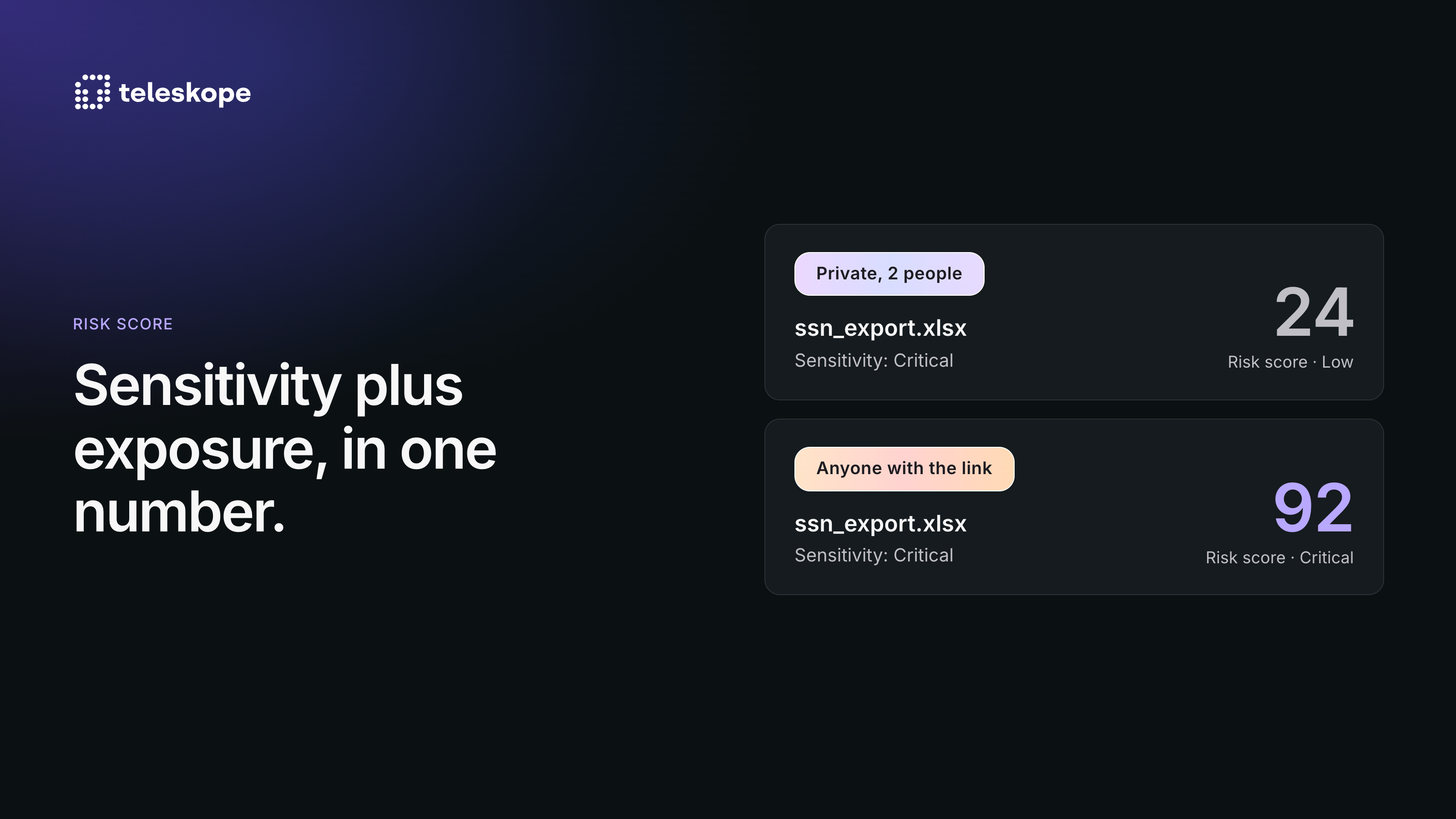
Teleskope combines DSPM and DLP in a single platform. It was built by security engineers who left Airbnb in 2022 after growing tired of tools that handed findings back and called it a day. Continuous scanning covers structured and unstructured data across AWS, Azure, GCP, SaaS apps like Slack and Zendesk, and on-premise SQL servers, flagging more than 150 sensitive data types (like PII, PHI, PCI, and secrets). The classification engine runs a multi-stage ML and GenAI pipeline at 99.3% accuracy, processing 40,000 items per second on a single GPU node, so a document is read as a document instead of a pile of regex hits.
The real separator with Teleskope is what happens after the match. Policies trigger deletion, redaction, masking, encryption, or access revocation natively at the source. Every action is auditable and reversible, and you can run enforcement in a fully automated way or keep a human approval gate on specific actions.
The Atlantic automated its deletion lifecycle and cut deletion time by 95% with a 97% drop in query costs. Ramp redacts PII in real time before it spreads through production. Kyte retired manual labeling across hundreds of terabytes. You can deploy Teleskope as single-tenant SaaS, managed, or fully self-hosted. Book a call.
2. Varonis
Varonis made its name based on file system permissions, and that heritage still defines the product. If your sensitive data problem lives in Windows file shares, NAS devices, SharePoint, Exchange, and Active Directory, few sensitive data discovery tools map effective permissions with the same depth. It answers the questions that stump most security teams inside a Microsoft estate: “Who can actually reach this folder, through which nested group, and when did they last open it?”
The platform has stretched into cloud data stores and SaaS, and it does automate some remediation, mostly permission changes and stale access cleanup. But be sure to scope the deployment honestly before you sign. Collector infrastructure, agents, and initial crawl times across large file estates make a two-week rollout unrealistic, and coverage of cloud warehouses and unstructured object storage still trails the on-prem story.
Best fit: Regulated enterprises with heavy legacy file infrastructure and a dedicated team to run the platform day to day.
3. Cyera
Cyera takes an agentless, API-connected route to discovery. Grant read access to your cloud accounts and SaaS tenants, and it assembles a data inventory across IaaS, PaaS, DBaaS, and object storage without putting anything in the data path. Classification leans on AI models rather than pattern libraries alone, which holds up better against messy production data than regex, and the identity layer connects datasets back to the people and roles who can reach them.
One caveat applies to every visibility-first platform: Findings arrive neatly prioritized, but fixing them routes through Jira, ServiceNow, or a cloud team's backlog. When your bottleneck is the queue rather than the discovery, you need to price that human cost into the evaluation.
4. IBM Guardium Data Protection
IBM Guardium Data Protection approaches discovery from the database outward. It sits next to the data stores themselves, watching activity across hybrid cloud and on-prem repositories, and it was built for teams whose auditors want query-level evidence instead of a dashboard screenshot. Discovery and classification feed straight into compliance automation, which explains why it lands on banking and healthcare shortlists where PCI DSS and HIPAA reporting cycles never actually end.
The real payoff is activity monitoring tied to classification. You can watch a service account pull from a table holding cardholder data, then apply blocking or masking policies right at the database layer. Few sensitive data discovery tools show you that much detail about what happens to data at the moment of access.
Plan for the operational load here. Guardium is agent and collector heavy, tuning runs for months, and coverage of SaaS collaboration surfaces like Slack or Google Drive was never the point of this product.
Best fit: Regulated enterprises with large database estates and a dedicated data security engineering function.
{{cs-1="/banners"}}
5. Spirion Sensitive Data Manager
Spirion has spent years working on one problem: finding sensitive data buried in endpoints, file shares, and unstructured content that nobody has inventoried in a decade. The product discovers structured and unstructured data with high accuracy, and shrinking the sensitive data footprint through classification is a stated design goal rather than a side effect.
Higher education and state governments buy it for one clear reason: When a records office has 40,000 documents on a shared drive and no idea how many contain SSNs, Spirion crawls them, classifies them, and supports persistent labels that travel with the file. It also handles remediation on discovered files (quarantine, redaction, deletion), which puts it well ahead of inventory-only products.
The tradeoff is architecture. Endpoint agents and scheduled scans mean that discovery happens on a cycle, so a file that turns risky on Tuesday may sit unflagged until the next scan window opens. It’s worth checking your on-prem file share scan cadence before you commit.
6. Datadog Sensitive Data Scanner
Most sensitive data discovery tools skip telemetry entirely, which is an odd blind spot considering how much PII ends up in application logs. Datadog Sensitive Data Scanner exists to close that gap. It discovers, classifies, and redacts sensitive data across logs, traces, RUM, and events, scanning at or before ingestion and hashing or redacting matches based on built-in or custom rules, which supports GDPR, HIPAA, and CCPA obligations.
Timing is where the value shows up. A card number written into a debug log by a payment service gets scrubbed before it reaches your observability store, so you skip filing a deletion ticket against a log index six weeks later. Engineering teams already living inside Datadog can switch this on without onboarding another vendor or another console.
Keep expectations straight, though, because this is not a data store discovery product. It will not tell you what sits in an S3 bucket, a Snowflake table, or a shared drive folder, so pair it with a data-layer platform rather than swapping one for the other.
7. Microsoft Purview Information Protection
Microsoft Purview Information Protection finds and labels sensitive content across the Microsoft estate: Exchange, SharePoint and OneDrive, Teams, and Windows endpoints. Sensitive information types cover the usual regulated identifiers, trainable classifiers handle document categories like contracts and source code, and sensitivity labels stay attached to the file, so encryption and access rules travel with it into an email attachment or a downloaded copy.
If your organization already pays for E5, this is the cheapest way to get a handle on Microsoft 365 sprawl. A label on a finance workbook can block external sharing and keep a Copilot response from surfacing its contents, which matters a lot given how fast Copilot inherits permissions that were already messy.
The limits are predictable here. Coverage outside Microsoft (S3 buckets, Snowflake, Postgres, Slack, Zendesk) is thin to nonexistent, label accuracy depends on tuning that most teams underestimate, and auto-labeling policies take days to simulate and roll out safely.
Best fit: Microsoft-centric organizations that want labeling and DLP tied to identity, paired with a broader platform for everything outside the tenant.
8. Apache Atlas
Apache Atlas is the open source metadata and governance project that came out of the Hadoop era, and it still earns a spot on shortlists for teams running Hive, HBase, Kafka, and Spark. It keeps a metadata repository with classifications, a searchable catalog, and column-level lineage, and it plugs into Apache Ranger so a classification like PII can drive a real access policy instead of sitting in a catalog entry nobody reads.
Data discovery starts with finding and cataloging what exists across scattered sources, and Atlas handles that part credibly for the big data layer at zero license cost. But be clear-eyed about the tradeoffs. Atlas does not scan file contents to find sensitive values on its own, so classification depends on hooks, tag propagation, or an external scanner feeding it. Unlike commercial sensitive data discovery tools, there is no vendor to page during a crisis, and the Solr, HBase, and Kafka dependencies underneath are yours to run.
Comparison Table
{{cs-2="/banners"}}
Conclusion
None of the sensitive data discovery tools on this list covers every surface, and pretending otherwise is how teams end up paying for three overlapping licenses while the same backlog sits untouched. The real difference between tools comes down to how much manual work sits between the finding and the fix. If your analysts spend their weeks writing tickets instead of closing gaps, discovery was never your bottleneck.
Map your actual data footprint first. Then pick the sensitive data discovery tool that handles the surfaces where your risk genuinely lives, and ask every vendor to show you remediation running end to end, not just a dashboard full of matches.