


TL;DR: Support agents paste customer account numbers to reproduce billing issues. Developers attach log files to bug reports. Screenshots carrying PII land in comment threads and never get read again. Because Jira projects are typically readable by every logged-in user in the instance, a single pasted value is effectively an org-wide disclosure. Teleskope now scans Jira issue summaries, descriptions, comments, attachments, and inline images, surfaces a finding within 15 minutes of the event, and removes the value from the ticket without requiring an Atlassian Guard Premium license.
Jira is where work gets done, which is exactly why sensitive data ends up there. The friction is low and the volume is high. A support agent pastes a customer account number to reproduce a billing issue. A developer attaches a log file to a bug report. An engineer drops a screenshot containing a PII field into a comment.
Then the issue is resolved. The ticket closes. The sensitive value stays.
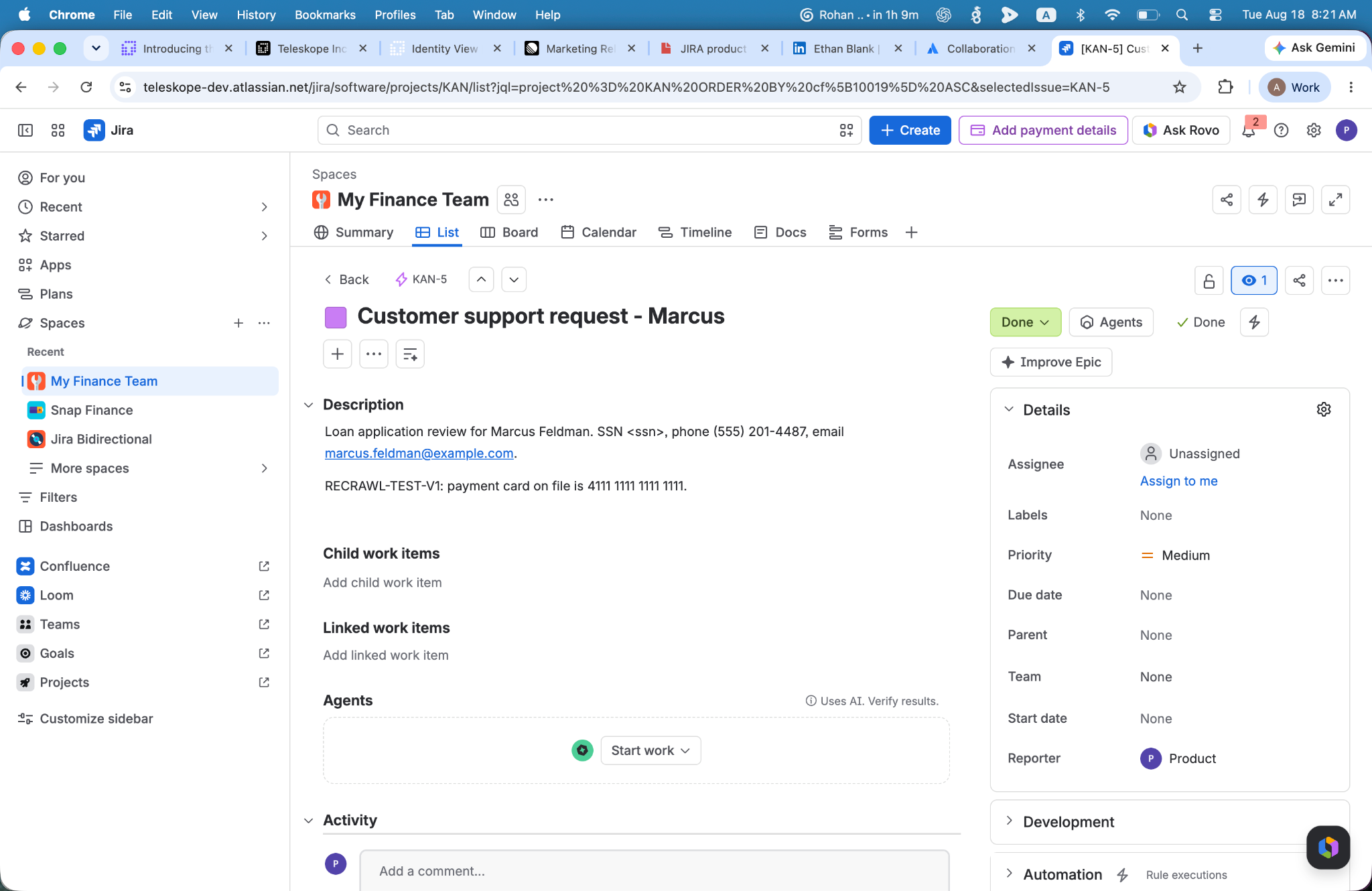
That is an exposure problem, not a hygiene problem. Jira projects are typically readable by every logged-in user in the instance, so a single pasted value is effectively an org-wide disclosure. And Jira retains everything: the current field value, the full comment thread, and a changelog of every prior value of every edited field, including values someone already tried to remove. Editing a description does not clean it up. The original text lives on in issue history.
Now add AI to the picture. Copilots and agents index ticketing systems because that is where institutional knowledge lives. The moment a model can read your Jira instance, every buried customer record in every stale comment becomes retrievable by anyone who knows how to ask.
Security teams have had no inventory of what sensitive data lives in Jira, no way to detect it as it arrives, and no remediation path that does not involve asking someone to go edit a comment by hand. Teleskope is changing that.
{{banner-large="/banners"}}
What the Jira connector covers
Teleskope scans Jira Cloud continuously and surfaces findings in the same unified catalog as every other source you already have connected. A finding in isolation tells you something happened. A finding correlated across your entire data landscape tells you what the risk actually is.
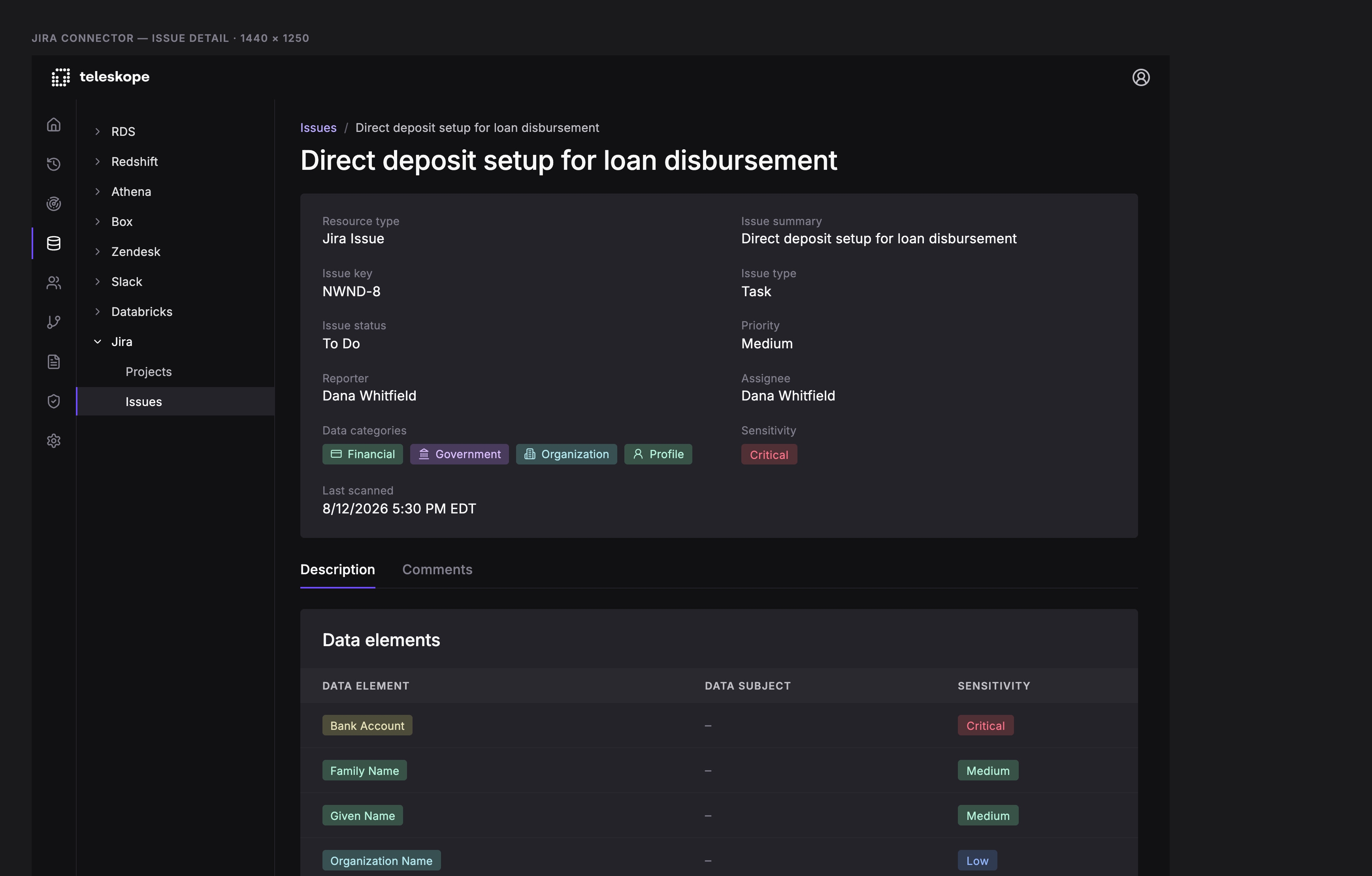
Coverage spans the surfaces where sensitive data concentrates in practice:
- Issue summaries and descriptions. The title and body of every ticket. Summaries are a high-frequency location for identifiers, since a line like "Refund for member 123-45-6789" pushes a regulated value into every search result and notification email that ticket generates.
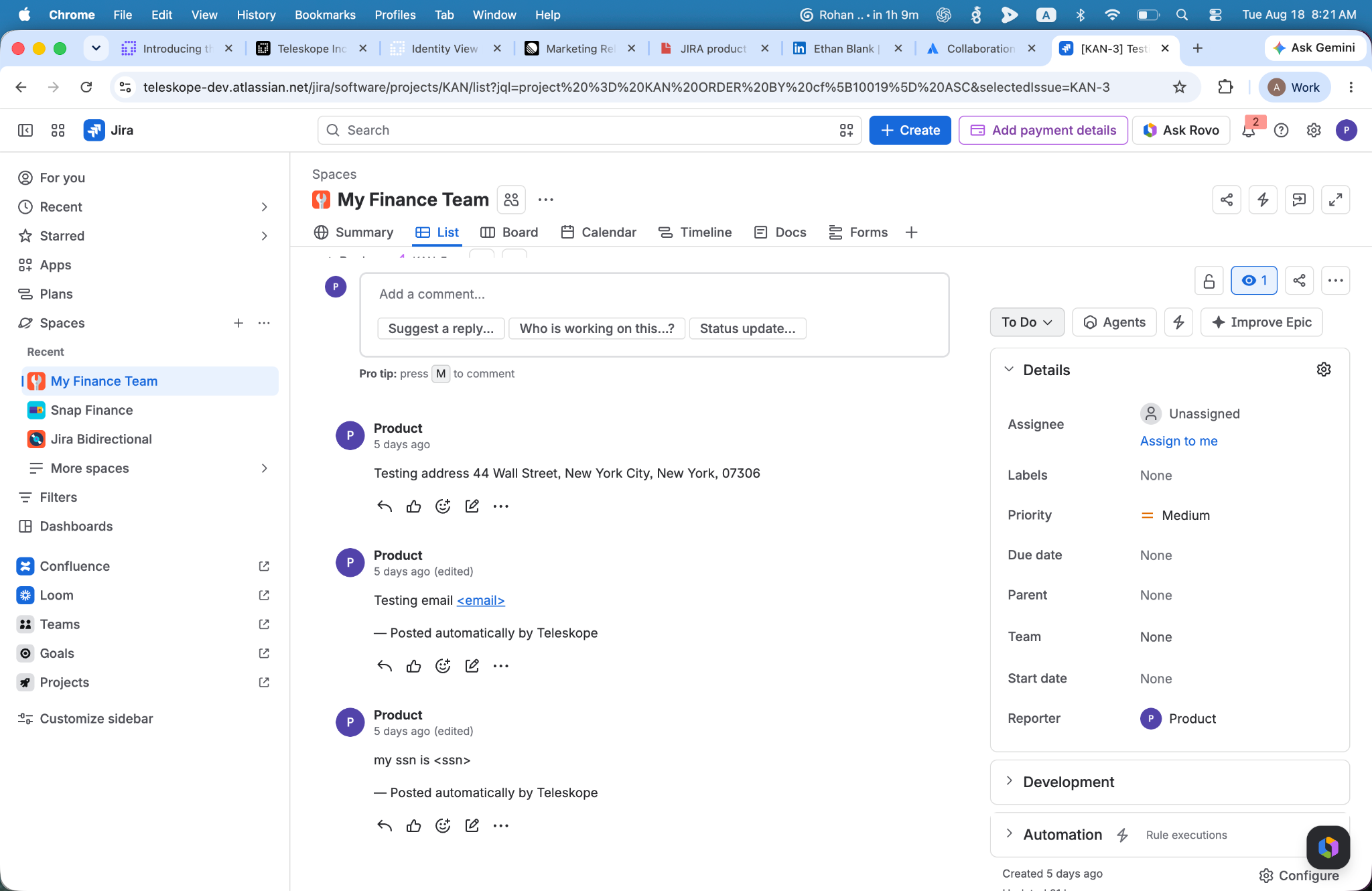
- Comments, including inline images. Comment bodies scan as text. Attachment-backed inline images take an OCR path through the existing classification pipeline, so a screenshot of a customer account page produces a finding the same way pasted text does.
- Attachments at both the issue and comment level. Binary downloads processed through the same pipeline that handles S3 and Google Drive, using the same classification library and the same custom data elements you have already configured.
Every finding lands in Data Explorer with the context your team needs to route it. Teleskope maps the Jira assignee to the record owner, and because assignees are frequently empty and change over a ticket's lifetime, ownership falls back to the reporter and then to the project lead. Your analysts get a named human to work with, not an unassigned ticket key.
Detection that keeps up with how Jira moves
The SLA matters here. Jira is a high-frequency surface. Support teams create dozens of tickets a day. Bug queues move fast. A detection system running a nightly batch job is not solving the problem, it is documenting it after the fact.
Teleskope surfaces a Jira finding within 15 minutes of the triggering event, measured from the event timestamp to the finding visible in Data Explorer at p95. In practice, a security engineer can paste a test credential into a ticket during an evaluation call and watch the finding land before the call ends.
That speed is what turns detection from a reporting tool into an operational control. Periodic scanning tells you what your exposure looked like last week. Near real-time detection lets you act while the ticket is still open, while the author still remembers writing it, and before the value propagates into an export, a Slack thread, or an AI assistant's context window.
Remediation that removes the value, not just the alert
Finding sensitive data in Jira is table stakes. Several DSPM vendors do some version of it. What separates a finding from a fix is whether the platform can reach into the ticket and take the value out.
Teleskope overwrites comment bodies in place, replacing the sensitive value while preserving the surrounding context that makes the ticket useful. This is a complete removal. Jira retains no prior comment versions and the changelog does not record them, so nothing is left behind for an API call to retrieve later. When a comment is not worth preserving, Teleskope deletes it outright. When the exposure lives in an attachment, Teleskope deletes the file and leaves a placeholder so the ticket does not silently break for the people still working it.
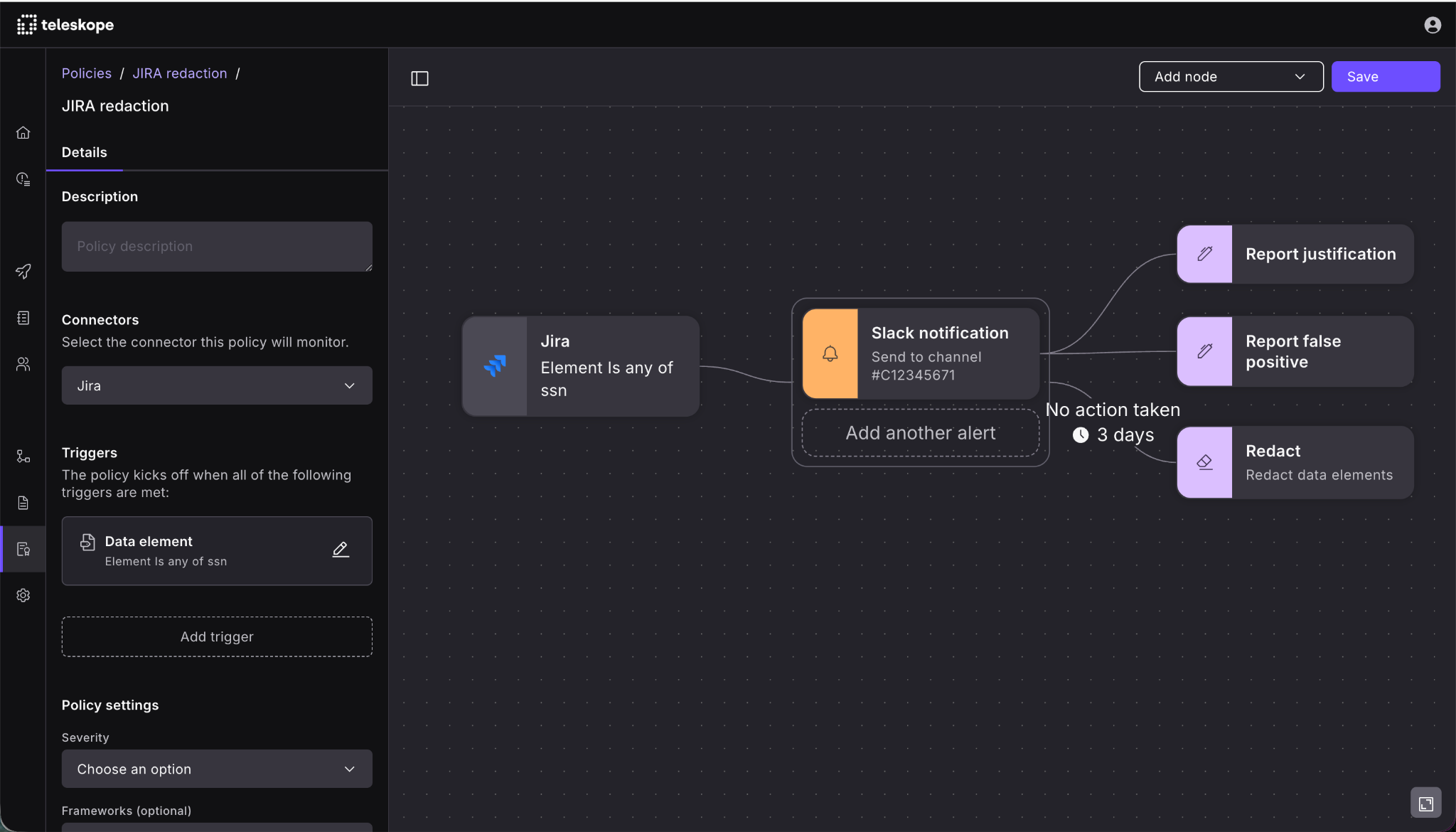
Every action runs through your existing policies. Your team decides which detections trigger which response, whether a human approves first, and who gets notified in Slack or email when a value is removed. The same policy engine governing your cloud and SaaS remediation now governs your ticketing system.
{{cs-1="/banners"}}
Atlassian Guard Premium, and where it stops
Atlassian sells its own answer to this problem, so it is worth being clear about what you get.
Guard Premium adds content scanning, redaction from an alert, classification labels, and policies that block export and public sharing. It works. It also lists at $8.18 per user per month and requires Guard Standard underneath it at another $4.20, so roughly $12.38 per user per month, billed on every managed account in your organization with no partial purchase. That is more than the Jira Standard seat it protects. For a 500-person organization, it is over $74,000 a year to secure exactly two products.
Guard secures Atlassian inside Atlassian. Your sensitive data does not stay there.
Who this matters most for
The organizations where this lands hardest are the ones where Jira carries regulated data by design. Healthcare organizations whose support and engineering teams work daily on systems handling PHI. Consumer financial services where member identifiers and account numbers move through engineering and support workflows constantly. Any organization under PCI DSS, HIPAA, or SOC 2 that runs Jira as a core operational tool.
The exposure profile is consistent across all of them: broad default access, high-velocity ticket creation, and no existing control that reaches inside ticket content.
{{cs-2="/banners"}}
Available now
Sensitive data in Jira has been invisible for as long as most security teams have used Jira. Not because the risk was unclear, but because no tool could see into tickets and no tool could clean them up. Your team can now inventory what is there, catch new exposures within minutes, and remove them without filing a request and hoping someone acts on it.
Watch a demo
Jira Cloud coverage is available as part of Teleskope's standard connector set. To see it running against your own instance, book a call.