


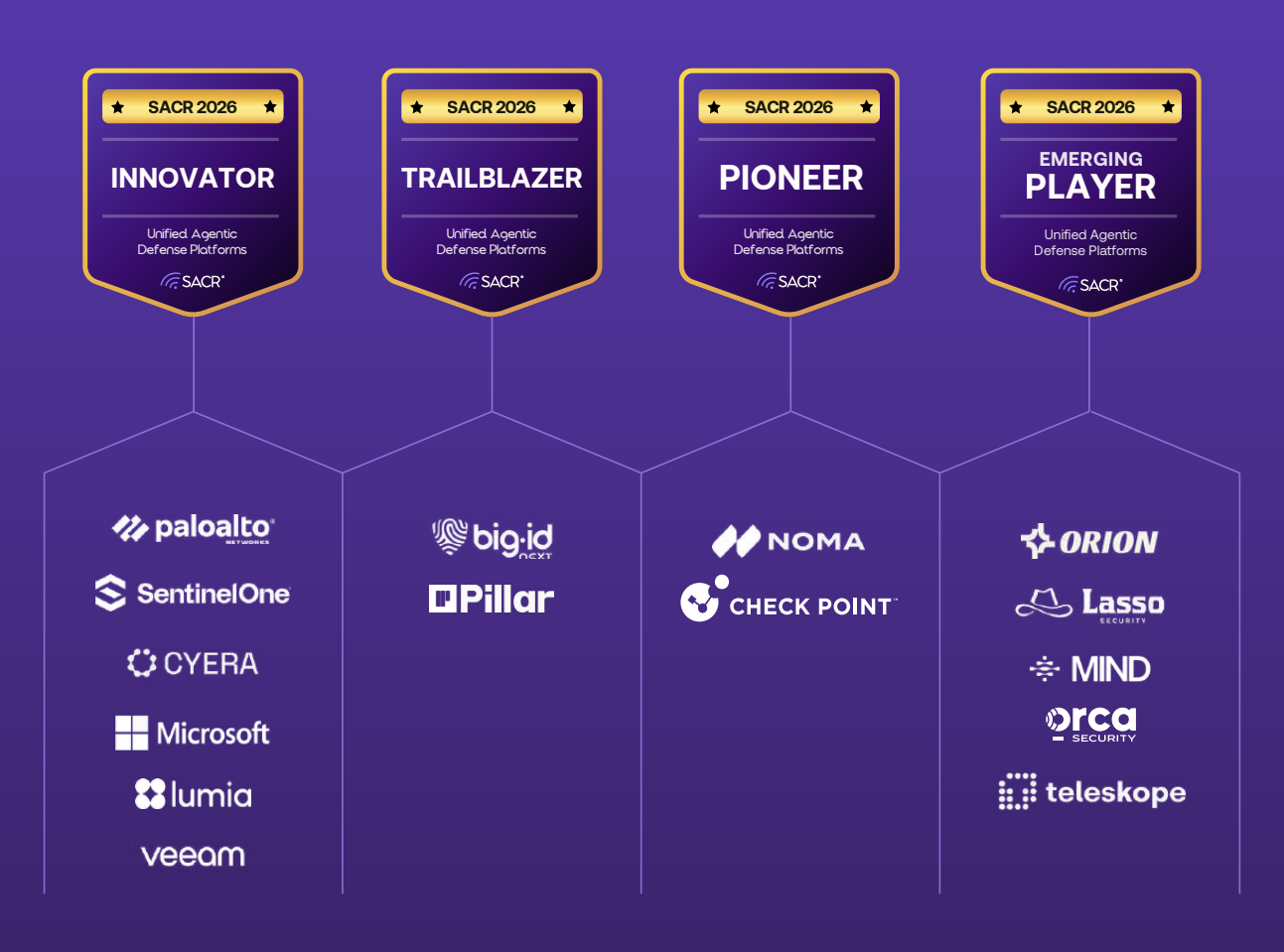
The February 2026 Software Analyst Cyber Research (SACR) Technoscope report didn't just evaluate vendors. It defined a new security architecture category: Unified Agentic Defense Platforms (UADP).
The core argument is straightforward. AI agents read files, call APIs, execute workflows, and operate with delegated authority across enterprise environments. Traditional security tools, including firewalls, static DLP rules, and CASBs, were built for deterministic software that follows predictable logic. They have no framework for governing systems that reason, interpret intent, and act autonomously at machine speed.
SACR's response to this gap was to map the vendors actively building toward a unified answer. Starting from a field of over 100 global vendors touching some component of AI or agent security, the analysts narrowed their detailed evaluation to 15 companies that best reflect the architectural direction of the broader market. Teleskope is one of them.
What the 2026 SACR Technoscope Report Says
The SACR report makes one argument above all others: you cannot secure autonomous AI agents without first securing the data they touch. Every RAG pipeline, every model fine-tuned on internal datasets, every AI copilot with access to file shares inherits the security strengths and weaknesses of the underlying data. If sensitive records are overexposed, misclassified, or ungoverned, AI systems don't just inherit that risk. They amplify it at scale.
The report also frames this as a legal and regulatory anchor. The U.S. Executive Order 14110 mandates rigorous red-teaming for foundation models. The EU AI Act establishes risk-based regulatory requirements for AI systems. SEC disclosure rules are tightening timelines for reporting material cybersecurity incidents. All of these converge on a single requirement: organizations need traceability and governance over every AI-driven data interaction.
For security leaders evaluating where to invest, the report signals a clear direction. Platforms that deliver automated, high-confidence remediation at the data layer have the structural advantage going forward. Vendors who treat data as the foundational control plane, rather than an afterthought bolted onto endpoint or network security, are the ones best positioned to win in this category.
What the UADP Category Demands
SACR structured its evaluation around six functional segments that together define what a mature UADP must address:
- Data Security: covering DSPM and DLP
- Discovery and Visibility: identifying unsanctioned AI usage across the organization
- Governance and Compliance: spanning the full AI lifecycle
- Visibility and Control of behaviors of Identities: for both human and non-human identities
- Runtime Protection and Prevention: defending AI systems during active operation
- Threat Detection and Response: closing the loop from alert to action
The report is direct about what separates meaningful platforms from noise in this space. Vendors who treat data as the foundational control plane, rather than an afterthought bolted onto endpoint or network security, have the structural advantage. The winners, SACR argues, will be those who can correlate identity (who or what is acting), data (what is being touched), and intent (why it is happening). Everything else is partial.
Why Teleskope Earned Its Place on the Technoscope
Most data security tools follow a familiar and frustrating pattern. They scan, classify, surface findings, and stop. Security teams inherit a growing queue of issues, each requiring manual investigation, context-gathering, and remediation that never quite keeps pace with the volume. The result is alert fatigue, operational cost, and risk that lingers.
Teleskope was built to break that cycle.
Teleskope processes data at 40,000 items per second on a single GPU node, classifying over 150 sensitive data types with 99.3% accuracy. But classification is only the starting point. Where most DSPM tools stop at reporting risk, Teleskope acts on it, automatically redacting exposed PII, revoking overly permissive access, enforcing retention policies, and relocating sensitive files to approved repositories. Every action is reversible and logged, which directly addresses the trust requirement SACR raises for automation operating at this speed and scale.
This is the distinction that earned SACR's attention. Automated, auditable remediation at the data layer is not a roadmap item for Teleskope. It is the core product.
“For CISOs, Teleskope.ai offers a pragmatic solution to the data sprawl crisis exacerbated by AI. If your organization is struggling with alert fatigue from traditional DSPM tools and needs a way to automatically sanitize data for AI adoption (e.g., Copilot readiness), Teleskope provides a high-value, operational focus on remediation that many larger platforms miss.” - SACR report
Built on the Right Foundation
SACR's thesis is that you cannot govern what AI agents access if you don't know what your data actually contains and who it belongs to. Every RAG pipeline, every model fine-tuned on internal datasets, every AI copilot with access to file shares inherits the security posture of the underlying data. Weak data governance doesn't stay contained. AI amplifies it at scale.
Teleskope's architecture starts at the data layer and works outward. It discovers and catalogs sensitive assets across AWS, Azure, GCP, SaaS applications, including Slack and Zendesk, and on-premise SQL servers, applying context that distinguishes between customer PII, employee records, and business metadata. That contextual depth is what makes safe AI adoption possible in practice, not just in principle.
For security teams navigating the shift to agentic AI, the question is not whether to secure the data layer. SACR's report makes clear that this is the only viable foundation. The question is which platform gets you there with confidence and without adding to operational burden. That is the problem Teleskope is solving.